
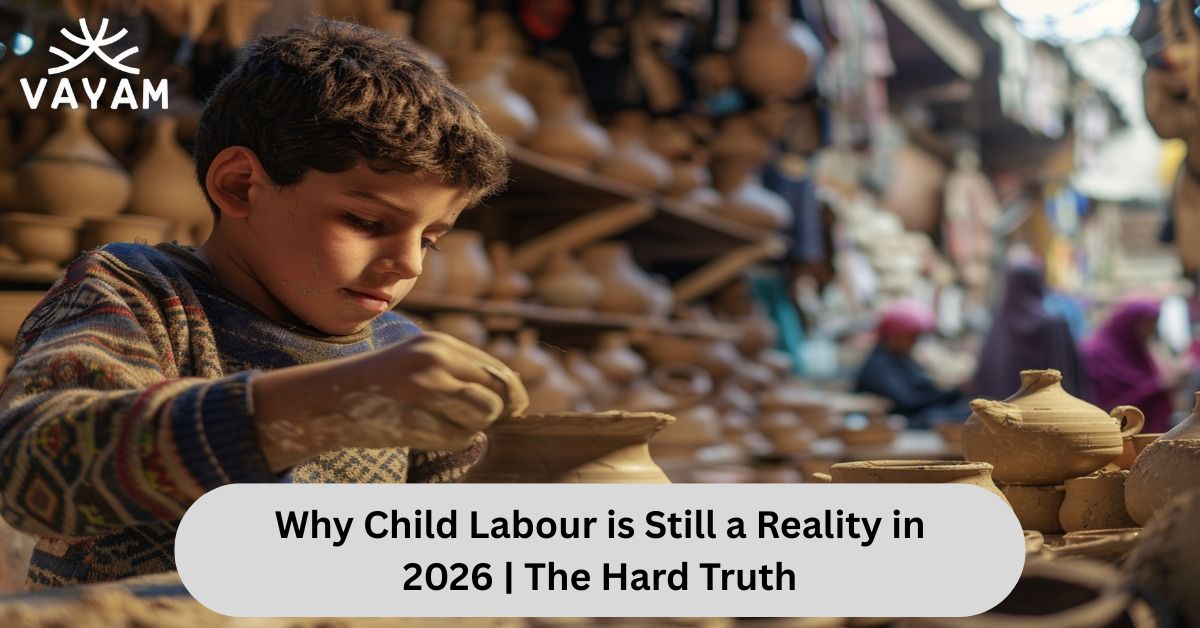
We imagine the future in sleek lines and digital glow. We talk about AI, interplanetary travel, and the metaverse. Yet, here in 2026, one of humanity’s oldest and most brutal injustices persists in the shadows of our global economy. This is the reality. A child’s hands, small and nimble, are not holding a tablet or a VR controller. They are picking cocoa beans, stitching soccer balls, mining cobalt, or weaving carpets.
The hard truth is that child labour was not a relic of the past. It is a present and ongoing crisis. Despite decades of advocacy, legislation, and corporate promises, an estimated 160 million children are still in child labour globally. Nearly half of them are in hazardous work. This is not an accident. It is a symptom of a system we have all built.
This blog post is an unflinching look at why. We will move beyond the simplistic headlines and confront the uncomfortable, interconnected reasons this exploitation endures. The answer isn’t a single villain. It is a web of economic pressure, broken systems, and our own consumption.
The Illusion of Progress: A Problem “Solved”?
For many, child labour feels like a solved problem. We saw the news stories in the 90s and early 2000s. Major brands were shamed. Laws were passed. Fair Trade labels appeared on shelves. The narrative became one of gradual, linear improvement.
That narrative was dangerously misleading. Progress has stalled and, in some regions, reversed. The COVID-19 pandemic, ongoing conflicts, and climate-driven disasters have plunged millions more families into desperate poverty, the primary engine of child labour.
Economic shocks act like a shockwave. When a family’s already precarious income vanishes, survival logic takes over. Sending a child to work isn’t a choice. It’s a necessity for the next meal. School closures during the pandemic didn’t just pause education. For many children, it was a one-way ticket into the labour force.
We must discard the comfort of thinking this is a developing world problem neatly contained elsewhere. The supply chains that feed our smartphones, our fashion, our food, and our electric cars are impossibly long and opaque. The child’s labour is baked into the price and the pace we demand.
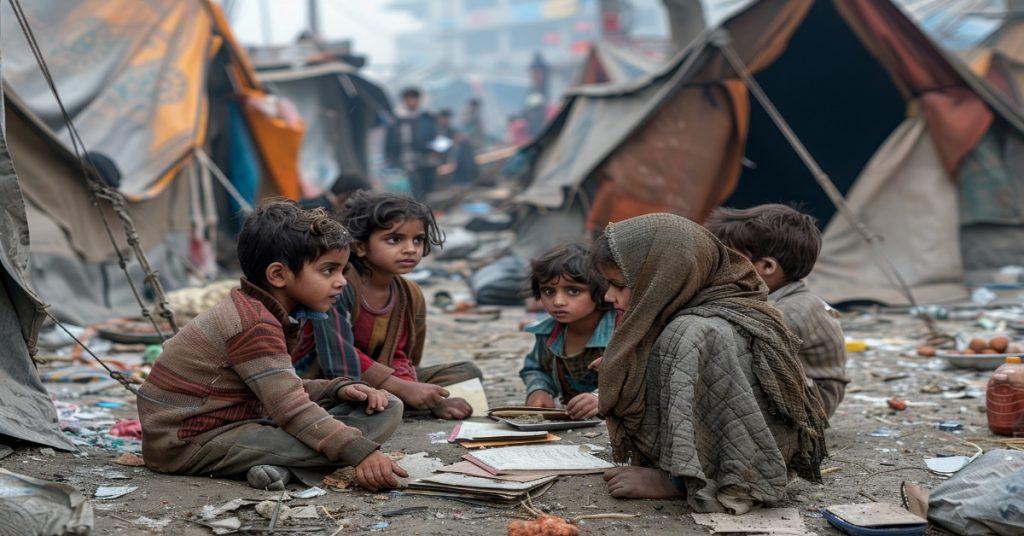
The Root Causes: It’s More Than Just Poverty
While systemic poverty is the undeniable bedrock, it interacts with other forces to create a perfect storm.
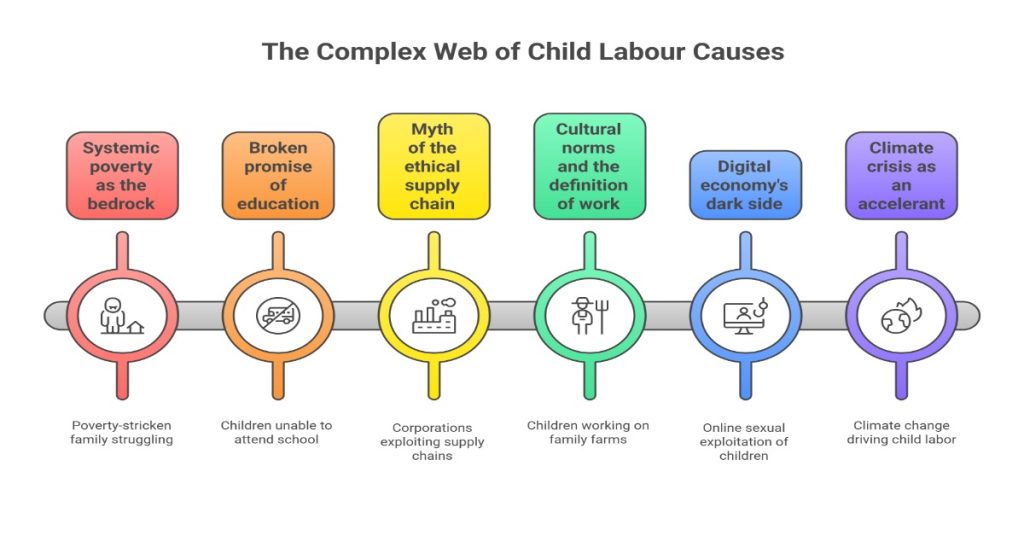
1. The Broken Promise of Education
Free schooling doesn’t always mean accessible or quality schooling. A common People Also Ask question is: Does lack of education cause child labour? The relationship is a vicious cycle. Poverty pushes children into work, which prevents them from attending school, which perpetuates their poverty.
But it’s deeper. Schools may be miles away, unsafe, or lack qualified teachers. The perceived return on investment from education can seem low to a family struggling today. If the curriculum isn’t relevant to their reality, the immediate, tangible income from a child’s labour wins. Education must be free, safe, quality, and seen as a viable path out of poverty.
2. The Myth of the Ethical Supply Chain
Modern supply chains are masterpieces of complexity and cost reduction. A single product can have components sourced from a dozen countries, through multiple sub contractors. This creates critical supply chain opacity.
Brands often have visibility only to their first tier suppliers. The further down the chain you go to the small farm, the home based workshop, the informal mine, the more the visibility fades. This isn’t always accidental ignorance. It’s often willful blindness. Audits can be announced in advance and are easily gamed.
When a major corporation pledges to eradicate child labour, the pressure doesn’t vanish. It cascades down the chain, squeezing the poorest link: the smallholder farmer or sub contractor. Their profit margins are slashed, and the only way to meet the order is to cut labour costs further, relying on the cheapest labour available.
3. Cultural Norms and the Definition of Work
In many agricultural communities, children working on family farms is seen as normal, even formative. This blurs the line between acceptable chores and exploitative child labour. The International Labour Organization defines child labour as work that is mentally, physically, socially, or morally dangerous and harmful to children and deprives them of schooling.
The challenge is intervention without cultural imperialism. Helping a family increase their yield or income so a child can study instead of performing hazardous farm labour is the path. Condemning all child work without offering alternatives can backfire, driving the practice further underground.
4. The Digital Economy’s Dark Side
A new frontier has emerged. Online sexual exploitation of children is a horrific form of child labour facilitated by technology. Driven by global demand, often from wealthier nations, children are coerced into producing content. This is child labour in the digital space, and it’s growing. It shatters the notion that this issue is confined to fields and factories.
5. The Climate Crisis as an Accelerant
This is the defining multiplier of our age. Climate change and child labour are directly linked. Droughts destroy harvests. Floods wipe out homes and livelihoods. When a family’s agrarian life becomes untenable, they migrate. Child migrant labour spikes as displaced families move to cities or new regions, where children become essential, vulnerable earners.
Climate change intensifies every existing driver. It deepens poverty, disrupts education, and fuels conflict over scarce resources. Our consumption patterns in the Global North are directly linked to the emissions that disrupt the climates of the Global South, creating a cruel feedback loop of exploitation.
The Path Forward: Beyond Awareness to Action
Awareness is no longer enough. We need a radical rethinking of our economic priorities. Here is where we must focus.
1. Demand Living Income, Not Just Living Wages.
The focus must shift from the worker to the producer. A cocoa farmer needs a living income that covers farm costs, household needs, and allows them to hire adult labour at a fair wage. This requires corporate purchasing practices that pay fair prices and honour long term contracts.
2. Support Mandatory Human Rights Due Diligence.
We must move beyond voluntary schemes. Legislation like the EU’s Corporate Sustainability Due Diligence Directive is crucial. It forces large companies to identify, prevent, and remedy human rights abuses in their entire value chain. Citizens must pressure their governments for such laws.
3. Invest in Social Protection Floors.
Governments, with international support, must build robust social protection systems. Cash transfers, universal child benefits, and public works programs for adults can act as a buffer. When a crisis hits, a family has a lifeline that doesn’t involve sending their child to work.
4. Make Education Truly Compelling and Accessible.
This means investing in school infrastructure, trained teachers, school meal programs, and flexible schedules for children who may still need to contribute at home. Education must be seen as the most valuable investment.
5. Be a Conscious, Political Consumer.
Our power is not just in our wallets, but in our voices. Research brands that go beyond certification to genuine ethical sourcing. Support companies advocating for sector wide change. More importantly, become a citizen advocate. Write to your elected representatives demanding strong supply chain transparency laws. Vote for policies that support global justice.

Answering Your Questions: The People Also Ask of Child Labour
Weaving through this complex issue, certain questions persistently arise. Let’s address them head on.
What are the main causes of child labour in 2026?
As outlined, the causes are interconnected. Abject poverty and economic shocks remain the core driver. This is compounded by inadequate social protection systems, broken or inaccessible education, opaque and demanding global supply chains, and the accelerating impacts of the climate crisis. It is a systemic failure, not an individual one.
Which industries have the most child labour?
While it exists in many sectors, the vast majority, around 70 percent, is in agriculture. This includes cocoa, coffee, tea, sugarcane, palm oil, cotton, and tobacco. The informal, seasonal, and family based nature of much farm work makes regulation exceedingly difficult.
Beyond agriculture, child labour is prevalent in mining and quarrying, manufacturing, construction, and domestic work, often hidden in private homes. The digital sector for sexual exploitation is a grave and growing concern.
What is being done to stop child labour?
Efforts exist on multiple levels. International laws like ILO Conventions 138 and 182 provide a framework. Many countries have national laws. Corporations adopt corporate social responsibility policies and conduct audits. NGOs run remediation and education programs.
The critical issue is enforcement and depth. Laws are poorly enforced, especially in informal economies. CSR is often a PR exercise without true supply chain transformation. The current system of voluntary corporate self policing is failing. The movement towards mandatory human rights due diligence laws in the EU and elsewhere is a significant, though early, shift.
How does child labour affect the world?
The impact is catastrophic and far reaching. For the child, it’s a stolen childhood, physical and psychological harm, and a life sentence to poverty without education. For society, it perpetuates cycles of poverty, depresses wages, and undermines education systems. It fuels instability.
For the global economy, it creates a distorted, unethical marketplace where products are artificially cheap because their true human cost is unpaid. It corrupts competition and poses immense reputational and legal risks for brands. Ultimately, it undermines our collective humanity and the sustainable development goals.
Can blockchain stop child labour?
Blockchain technology is often proposed as a silver bullet solution for supply chain transparency. The idea is that every step of a product’s journey, from farm to shelf, could be immutably recorded.
In theory, it’s promising. In practice, it’s limited. Blockchain can verify data, but it cannot verify the truth of that data at its source. Who inputs the information at the cobalt mine or the cotton farm, and under what pressure? It is a tool, not a solution. True change requires empowering workers, ensuring living wages, and shifting power dynamics, not just creating a more sophisticated audit trail.
Read More
How to Support Ethical Businesses That Fight Against Child Labour?

The Hidden Connection: How Human Trafficking Fuels Child Labour in India?

India’s Child Labour Crisis: What Needs to Change Now
Conclusion: The Hard Truth of Our Interconnection
The child labourer in 2026 is not a distant statistic. They are the hidden cost of our cheap chocolate, our fast fashion, and our relentless upgrade cycle. They are the collateral damage of a global economy built on extraction and inequality.
The hard truth is that this system serves us, the consumers in the wealthy world. It gives us lower prices and endless variety. Eradicating child labour will cost. It will mean higher prices, slower turnarounds, and less convenience. It requires us to confront the fact that our comfort is partially built on the suffering of children.
We stand at a crossroads. We can choose the facade of a tech driven future while ignoring its foundation of exploitation. Or we can choose to build a different kind of economy, one that values human dignity over profit margins, and sees every child’s potential as the most precious resource we have.
In 2026, the question is no longer why does child labour exist. We know why. The question now is: What are we willing to change to end it. The answer to that question will define our true legacy for generations to come.