
The Right to Education (RTE) Act has transformed how millions of Indian families access quality schooling. But here’s what many parents don’t realize: not all RTE schools offer the same facilities, and knowing how to identify the best ones can dramatically impact your child’s educational journey.
Finding an RTE school with excellent facilities isn’t about luck. It’s about knowing where to look, what to ask, and how to evaluate what truly matters for your child’s development.
Understanding RTE Schools and Why Facilities Matter
The RTE Act mandates that private schools reserve 25% of their seats for children from economically weaker sections and disadvantaged groups. This constitutional right ensures free education from Class 1 to Class 8.
But the quality of facilities varies enormously between schools. Some offer state-of-the-art science labs and sports complexes, while others provide only basic infrastructure.
Your child will spend roughly 1,200 hours at school each year. The quality of classrooms, playgrounds, libraries, and other facilities directly influences their learning experience, physical development, and overall happiness.
What Defines “Best Facilities” in RTE Schools?
Before you start your search, understand what constitutes quality facilities. The RTE Act specifies minimum infrastructure requirements, but the best schools go far beyond these basics.
Essential Infrastructure Requirements
Every recognized RTE school must provide:
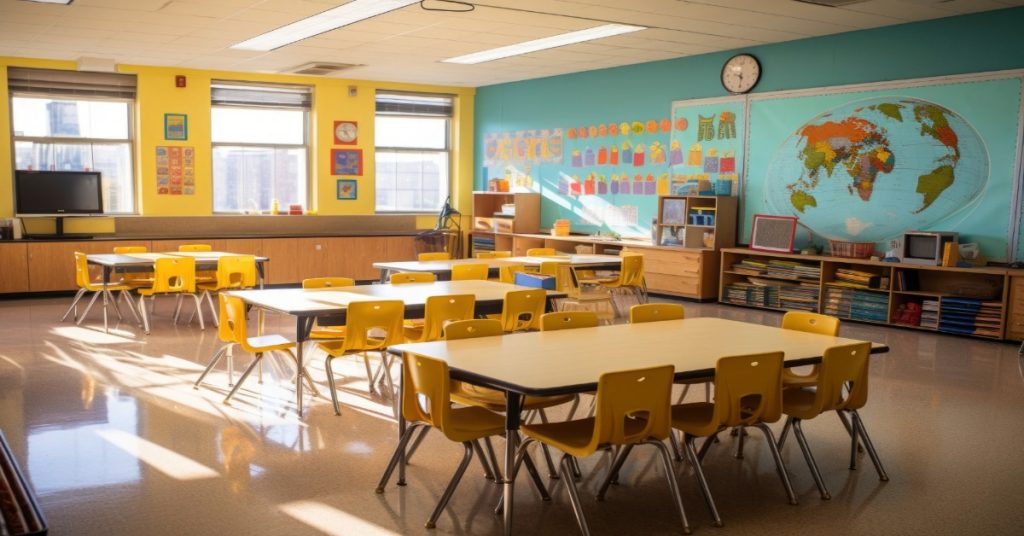
Classroom Facilities: Well-ventilated rooms with proper lighting, adequate space (minimum 0.97 square meters per child), furniture appropriate for children’s age groups, and clean, maintained walls and floors.
Sanitation and Hygiene: Separate toilets for boys and girls, functional drinking water facilities, handwashing stations, and regular cleaning protocols.
Safety Measures: Boundary walls or fencing, secure entry and exit points, fire safety equipment, first aid facilities, and CCTV cameras in common areas.
Premium Facilities That Set Schools Apart
The truly exceptional RTE schools offer:
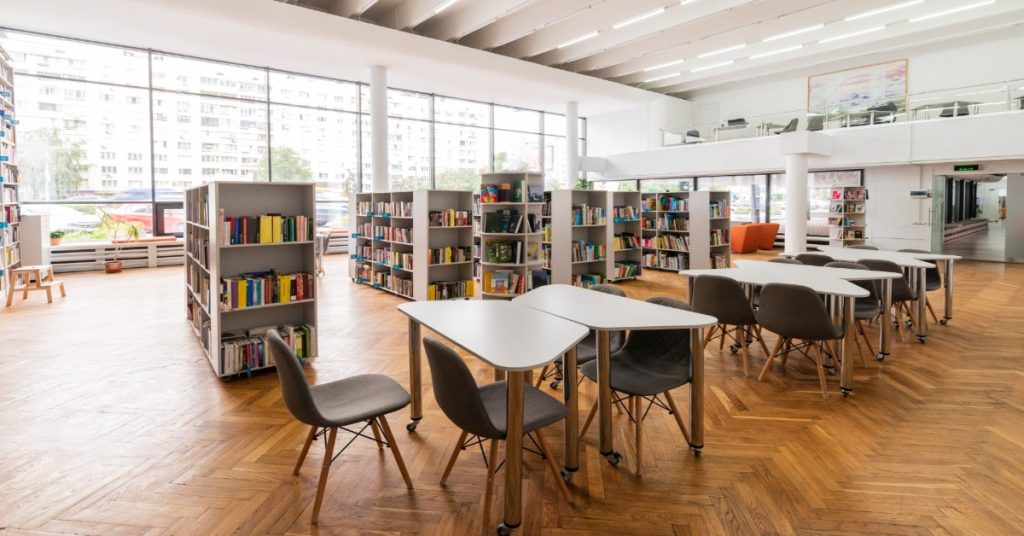
Learning Resources: Well-stocked libraries with age-appropriate books, computer labs with internet connectivity, science laboratories with working equipment, and dedicated spaces for arts and crafts.
Sports and Recreation: Playgrounds meeting minimum size requirements, sports equipment for various activities, indoor game facilities, and qualified physical education instructors.
Special Education Support: Facilities for children with special needs, ramps and accessible toilets, learning support resources, and trained special educators.
Modern Amenities: Smart classrooms with digital learning tools, audio-visual equipment, air-conditioned or well-ventilated spaces, and transportation facilities.
Step-by-Step Process to Find RTE Schools with Top Facilities
Step 1: Start Your Research Online
The digital revolution has made finding RTE schools significantly easier. Most state governments maintain online portals listing recognized schools under the RTE quota.
Visit your state’s education department website. Look for sections titled “RTE Admission,” “EWS Admission,” or “25% Quota Schools.” These portals typically provide school names, addresses, contact details, and sometimes facility information.
Download the complete list of RTE schools in your area. Create a spreadsheet to organize this information, including columns for school name, distance from home, contact details, and facilities offered.
Use Google Maps to mark school locations. This visual representation helps you understand which schools are genuinely accessible for daily commutes.
Step 2: Check Government Databases and Recognition Status
Not every school claiming RTE seats is properly recognized. Verify each school’s credentials through official channels.
Access the National Commission for Protection of Child Rights (NCPCR) website. They maintain data on RTE implementation and school recognition status across India.
Check the school’s recognition certificate. Every legitimate school displays recognition numbers from the state education board. Note these numbers and cross-verify them on the board’s official website.
Look for UDISE codes (Unified District Information System for Education). This 11-digit code uniquely identifies every recognized school in India and confirms its official status.
Step 3: Leverage Parent Networks and Community Resources
Other parents are your most valuable resource. Their real-world experiences provide insights no brochure can match.
Join local parent groups on Facebook, WhatsApp, or community forums. Search for groups specific to RTE admissions or general school admissions in your city.
Ask specific questions about facilities. Instead of “Is this a good school?”, ask “How is the science lab?” or “What sports facilities do they actually use?”
Connect with parents whose children currently attend shortlisted schools. Request honest feedback about infrastructure maintenance, availability of announced facilities, and whether promises match reality.
Visit neighborhood community centers or NGOs working on education. Many maintain databases of school information and can guide you toward well-facilitated RTE schools.

Step 4: Conduct Physical School Visits
Nothing replaces seeing facilities with your own eyes. Plan systematic school visits during working hours.
Call ahead to schedule appointments. While some schools allow walk-ins, a scheduled visit ensures someone can show you around properly.
Prepare a checklist of facilities to inspect. Carry a notebook or use your phone to document what you observe at each school.
Visit during school hours, not holidays. This lets you see facilities in actual use, observe maintenance standards, and gauge the general atmosphere.
Bring your child along if possible. Their comfort level and excitement about the environment matter enormously for their future adjustment.
Step 5: Evaluate Facilities Using a Standardized Checklist
Create a detailed evaluation form to rate each school consistently. This systematic approach prevents emotional decision-making.
Classroom Assessment Checklist:
- Are classrooms spacious and well-lit?
- Is furniture child-sized and in good condition?
- Are there educational displays on walls?
- Is the teacher-student ratio reasonable?
- Are classrooms clean and well-maintained?
Library and Learning Resources:
- Does the library have books for different age groups?
- Are there newspapers, magazines, and reference materials?
- Is there a proper cataloging system?
- What are the borrowing policies for students?
- Is the space inviting and well-organized?
Science and Computer Labs:
- Are labs equipped with working instruments?
- Do students actually conduct experiments regularly?
- Are safety measures (fire extinguishers, first aid) present?
- Is computer lab equipment modern and functional?
- What is the computer-to-student ratio?
Sports and Physical Education:
- What is the playground size and surface quality?
- What sports equipment is available?
- Are there qualified PE teachers?
- How many sports periods occur weekly?
- Are there indoor game facilities?
Sanitation and Hygiene:
- Are toilets clean and functional?
- Is running water available consistently?
- Are there sufficient toilets for the student population?
- Are sanitation facilities accessible for children with disabilities?
- What are the cleaning schedules?
Safety and Security:
- Is the premises boundary secure?
- Are entry/exit points monitored?
- Is there CCTV coverage in appropriate areas?
- Are emergency exits clearly marked?
- Is there a medical room with basic supplies?
Rate each category on a scale of 1-5, with specific notes about strengths and concerns.

Red Flags to Watch Out For
Some warning signs indicate a school may not maintain the facilities it advertises.
Restricted Access: Schools that refuse facility tours or limit them to only certain areas may be hiding inadequate infrastructure. Transparent schools willingly show their entire campus.
Outdated or Broken Equipment: Libraries with dusty, decades-old books, computer labs with non-functional equipment, or science labs used as storage rooms signal neglect.
Poor Maintenance: Broken furniture, leaking ceilings, dirty toilets, or peeling paint indicate the school doesn’t prioritize infrastructure upkeep. If basic maintenance is ignored, facility quality will only decline.
Overcrowded Classrooms: Classrooms packed beyond capacity compromise learning quality regardless of other facilities. RTE norms specify maximum student numbers per classroom.
Missing Safety Measures: Absence of first aid kits, fire extinguishers, or basic safety protocols is unacceptable. Your child’s safety cannot be compromised.
Vague Responses: Staff unable to provide specific information about facilities, timings, or access policies suggests poor organization or facilities that exist only on paper.
How to Compare Multiple RTE Schools Effectively?
Once you’ve visited several schools, systematic comparison prevents confusion.
Create a comparison matrix with schools as columns and facility categories as rows. Use your 1-5 ratings to populate this matrix, making strengths and weaknesses visually apparent.
Weight different factors based on your priorities. If your child is sports-oriented, give higher weight to athletic facilities. For academically inclined children, prioritize libraries and labs.
Consider the complete package, not just individual facilities. A school with an excellent library but poor sanitation isn’t ideal. Balance across all essential categories matters most.
Factor in accessibility and convenience. Even the best-facilitated school becomes problematic if the daily commute is stressful or unsafe for your child.
Revisit your top two or three choices. A second visit often reveals details you missed initially and confirms your first impressions.
Understanding the RTE Admission Process
Knowing the admission timeline and process helps you act decisively once you identify the right school.
Timeline Awareness: RTE admissions follow strict schedules that vary by state but typically occur between January and May. Missing these windows means waiting another year.
Application Procedures: Most states now have online application systems. You’ll need documents proving residence, age, and eligibility under EWS/DG categories.
Required Documents: Typically include birth certificate, residential proof, income certificate, caste certificate (if applicable), passport-size photographs, and Aadhaar card.
Lottery System: When applications exceed available seats, most states conduct random computerized lotteries. Understanding these mechanics helps set realistic expectations.
Waiting Lists: Being on a waiting list isn’t the end. Many seats become available as families decline admissions or fail to complete formalities.
Making Your Final School Selection
You’ve researched, visited, and compared. Now comes the decision.
Involve your child in age-appropriate ways. Show them photos, discuss what they’d like (friends, playground, library), and gauge their enthusiasm about different options.
Trust your instincts about the school’s atmosphere. Beyond facilities, the warmth of staff, the happiness of current students, and the general vibe significantly impact your child’s experience.
Consider growth and sustainability. Will the school continue maintaining these facilities? Do they have plans for upgrades? Financial stability and management quality matter for long-term quality.
Have an honest family discussion about expectations. Ensure everyone understands what the chosen school offers and doesn’t offer.
Make a final visit before submitting applications. Confirm nothing has changed and that your earlier impressions still hold true.

People Also Ask: Essential RTE School Questions Answered
What are the minimum infrastructure requirements for RTE schools?
According to RTE Act Schedule I, schools must provide all-weather buildings with at least one classroom per teacher, a head teacher’s office, toilets for boys and girls, safe drinking water, kitchen for mid-day meals, playground, and boundary walls or fencing.
Additionally, schools need furniture for all children, a library with newspapers and books, teaching-learning materials, and sports equipment. These are minimum standards, and many schools, especially established private institutions, offer significantly better facilities.
The specific requirements vary slightly for primary schools (Classes 1-5) and upper primary schools (Classes 6-8), with upper primary requiring science labs and computer facilities.
How can I verify if a school is genuinely recognized under RTE?
Start by checking your state education department’s official website, which maintains lists of recognized schools eligible for RTE admissions. Every recognized school has a unique recognition number issued by the state board.
Cross-verify this recognition number on the concerned educational board’s website (CBSE, ICSE, or State Board). The school should prominently display this certificate on campus.
Check the school’s UDISE code on the Department of School Education and Literacy website. This 11-digit code confirms the school’s registration in the national education database.
You can also contact your state’s RTE helpline or visit the District Education Officer’s office with the school’s name and address for official confirmation.
Do RTE quota students get access to all school facilities equally?
Yes, absolutely. The RTE Act explicitly prohibits discrimination between fee-paying students and those admitted under the 25% quota. Section 13 states that schools cannot discriminate based on admission category regarding curriculum, facilities, or any other aspect.
Children admitted under RTE must receive identical access to libraries, laboratories, sports facilities, extracurricular activities, and all other amenities available to other students. Any discrimination is legally punishable.
If you encounter discrimination, immediately document it and report to your District Education Officer, State RTE Authority, or file a complaint with the National Commission for Protection of Child Rights.
Schools violating non-discrimination provisions can face penalties including fines and potential derecognition. Parents should be aware of these rights and assert them confidently.
What should I do if the school’s actual facilities don’t match what was advertised?
First, document the discrepancies through photographs and written notes comparing advertised claims with actual conditions. Collect any brochures, website screenshots, or promotional materials making false claims.
Approach the school administration formally with your concerns. Sometimes issues arise from poor communication rather than intentional deception, and schools may address legitimate grievances.
If the school is unresponsive, file a written complaint with your District Education Officer, copying the State RTE Authority. Include all documentation proving misleading representation.
For serious violations like absent mandatory facilities (toilets, drinking water, boundary walls), contact the National Commission for Protection of Child Rights through their online complaint portal at ncpcr.gov.in.
Consider whether the actual facilities, while different from advertisements, still meet your child’s needs. If yes, you might proceed with admission while ensuring the complaint creates pressure for improvements.
Can I change my child’s school after RTE admission if facilities are inadequate?
Yes, though the process involves specific steps. Under the RTE Act, you can request a transfer to another school if the current institution fails to provide mandatory facilities or violates act provisions.
Document all facility inadequacies through photographs, written complaints to school administration (keep copies), and witness statements from other parents if possible.
Apply to your preferred new school under RTE quota, explaining the reasons for transfer request. Simultaneously inform your District Education Officer about the situation through a formal application.
The new school cannot refuse admission if seats are available under the RTE quota and your transfer request is supported by valid reasons. The education department facilitates such transfers when justified.
Be aware that frivolous transfer requests may be rejected, but genuine cases involving safety, hygiene, or infrastructure violations are typically accommodated. The child’s best interest remains the paramount consideration.

Regional Variations: Understanding State-Specific RTE Implementation
RTE implementation differs across Indian states, affecting how you find and evaluate schools.
Portal Differences
States like Delhi, Maharashtra, and Karnataka have sophisticated online portals with detailed school information, including facility lists and parent reviews. Others maintain basic databases requiring more independent research.
Some states allow online facility verification through geotagged photos uploaded by schools. Use these resources when available to pre-screen schools before physical visits.
Admission Timelines
Southern states typically begin RTE admission processes earlier (January-February) than northern states (March-April). Check your state education department website for exact dates annually.
Facility Standards
Some states mandate facilities beyond central RTE requirements. For example, certain states require CCTV cameras, while others mandate specific playground sizes or computer-to-student ratios.
Research your state’s specific RTE rules document, usually available as a PDF on the education department website. This reveals additional facility requirements schools must meet.
The Role of NGOs and Education Support Organizations
Numerous organizations work to improve RTE implementation and can assist your search.
How NGOs Can Help?
Organizations like Pratham, Akshara Foundation, and state-specific education NGOs maintain school databases, conduct facility audits, and provide free counseling for RTE admissions.
Many NGOs run helpdesks during admission season, helping parents with documentation, online applications, and school selection. These services are typically free or low-cost.
Search online for “RTE admission support” along with your city name to identify local organizations offering assistance.
Community Learning Centers
Some areas have community learning centers that provide supplementary education. These centers often have relationships with multiple schools and offer valuable insights into facility quality.

Technology Tools to Enhance Your School Search
Modern tools make finding well-facilitated RTE schools more efficient.
Mobile Apps
Several states have official mobile apps for RTE admissions featuring school listings, application tracking, and facility information. Download your state’s app from official government sources only.
Apps like SchoolBrainer and Edustoke (where available) provide crowdsourced school reviews, though verify information through official channels.
Online Review Platforms
Websites aggregating school reviews can provide facility insights, but approach reviews critically. Look for specific, detailed feedback about infrastructure rather than generic praise or complaints.
Check multiple platforms and look for consistency in feedback. One negative review may be an outlier, but recurring complaints about specific facilities deserve attention.
Virtual Tours
Post-pandemic, some schools offer virtual tours showcasing facilities. While not replacements for physical visits, these provide initial screening efficiency, letting you shortlist schools worth visiting in person.
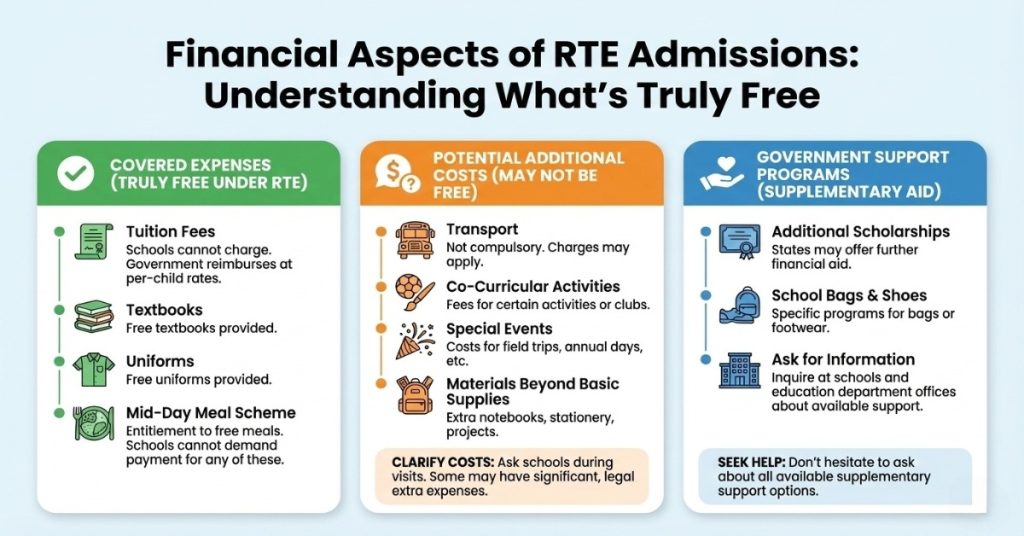
Financial Aspects: Understanding What’s Truly Free
While RTE admissions are free, understanding the complete financial picture prevents surprises.
Covered Expenses
Under RTE, the school cannot charge tuition fees from quota students. The government reimburses schools at per-child rates calculated by the state.
Students receive free textbooks, uniforms, and entitlement to the Mid-Day Meal scheme. Schools cannot demand payment for these items.
Potential Additional Costs
However, schools may charge for items outside the RTE mandate: transport (not compulsory), certain co-curricular activities, special events, or materials beyond basic supplies.
Clarify these potential costs during school visits. Some well-facilitated schools have significant additional expenses that, while legal, may strain your budget.
Government Support Programs
Many states offer additional scholarships for uniforms, school bags, or shoes beyond RTE mandates. Ask schools and education department offices about available supplementary support.
Long-Term Considerations: Facilities Through Your Child’s School Journey
Think beyond immediate needs to your child’s entire educational arc.
Growth and Development
A school perfect for Class 1 should support your child through Class 8. Check if facilities evolve appropriately for older students—science labs suitable for Class 8 experiments, libraries with age-appropriate teenage literature, sports programs for developing children.
Expansion Plans
Ask about the school’s infrastructure development roadmap. Growing schools invest regularly in facility upgrades. Declining or stagnant schools may see facility quality deteriorate.
Alumni Success
Schools maintaining quality facilities typically produce successful students. Ask about recent alumni achievements as indirect evidence of sustained infrastructure quality.
Special Considerations for Children with Special Needs
If your child has special needs, facility requirements become even more critical.
Accessibility Infrastructure
Check for ramps, accessible toilets, elevators (in multi-story buildings), and wheelchair-friendly pathways. The RTE Act mandates inclusive education, requiring appropriate facilities.
Learning Support Resources
Look for resource rooms, assistive technologies, special education materials, and trained staff to support diverse learning needs.
Sensory Considerations
For children with sensory sensitivities, assess noise levels, lighting quality, and availability of quiet spaces for regulation and calm-down time.
Building a Relationship with Your Chosen School
Once you’ve selected a school, proactive engagement ensures facilities remain accessible and well-maintained.
Join the Parent-Teacher Association
Active PTA participation gives you voice in facility-related decisions and maintenance priorities. PTAs often organize fundraisers for facility improvements.
Volunteer for School Activities
Volunteering increases your presence on campus, keeping you informed about facility conditions and any emerging issues.
Maintain Open Communication
Develop positive relationships with teachers and administrators. When concerns arise, you’ll have established channels for addressing them constructively.
Document and Advocate
If facility issues develop, document them professionally and work through proper channels for resolution. Your advocacy can improve conditions for all students.
Read More
Can You Apply for RTE If Your Income Exceeds the Limit?

Government Schemes for RTE Graduates: What’s Next?

How RTE Act Impacts Private Schools in India?
Conclusion: Empowering Your Child Through Quality Education
Finding an RTE school with excellent facilities requires effort, but the rewards of your child’s enriched learning experience, safety, and developmental opportunities make this investment invaluable.
Remember that facilities are means to an end: your child’s education, growth, and happiness. The best school balances strong infrastructure with caring teachers, positive culture, and genuine commitment to student development.
Start your search early, use systematic evaluation methods, trust both data and instincts, and remember that you’re not just choosing a building but selecting an environment that will shape your child’s formative years.
The Right to Education Act gave your child access to quality schooling regardless of economic circumstances. By diligently researching facilities and making informed choices, you ensure this constitutional right translates into genuine educational opportunity.
Your thorough facility evaluation today creates the foundation for your child’s successful, enriching school experience tomorrow. Take the time to get it right and your child’s future is worth it.