
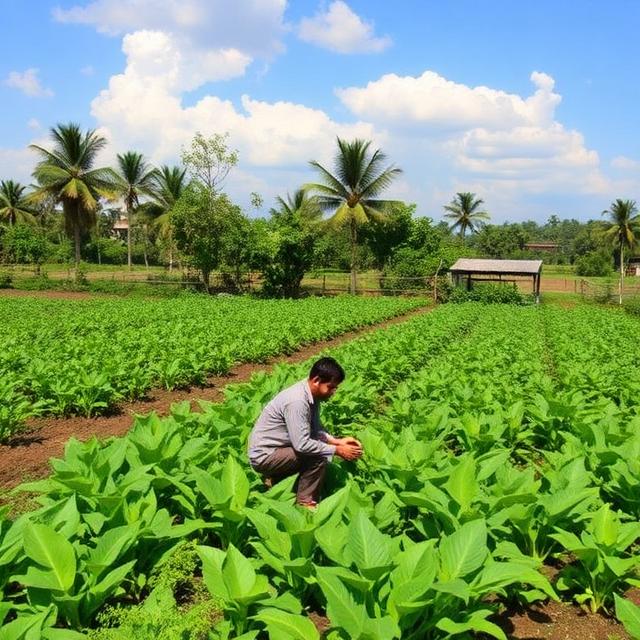
Sustainable agricultural transformation in India has reached a critical turning point in 2026. With nearly 140 million farmers feeding over 1.4 billion people, the sector is shifting from traditional, input-heavy methods toward Climate-Smart Agriculture (CSA)—a model designed to maintain productivity despite erratic monsoons, heat stress, and degrading soil.
The Three Pillars of India’s Strategy
India’s approach to CSA is built on a “Triple Win” framework to ensure long-term food and economic security:
- Sustainable Productivity: Increasing yields and farmer incomes—especially for the 86% who are smallholders—without further depleting natural resources.
- Enhanced Resilience: Building the capacity of farming systems to withstand shocks like floods, droughts, and emerging pest threats.
- GHG Mitigation: Reducing agricultural emissions, which currently account for nearly 14-18% of India’s total greenhouse gas footprint.
2026 Technological Frontier: Data as the New Fertilizer
By 2026, technology is no longer a luxury; it is becoming a mainstay for millions of farmers through several key innovations:
- AI-Powered Advisory (Bharat Vistar): Launched in the Union Budget 2026, this multilingual platform integrates satellite, weather, and soil data to give farmers real-time, field-specific advice on planting and nutrient management.
- Precision Agriculture: Over 70% of Indian farmers are expected to adopt digital tools by 2026. This includes using IoT sensors for real-time soil monitoring and drones for targeted spraying of fertilizers and pesticides to reduce waste.
- Climate-Resilient Seeds: The government recently introduced 109 new high-yielding, climate-resilient varieties across 32 field and horticultural crops, including “Scuba Rice” that can survive prolonged underwater submersion.
- AgriStack & Digital IDs: More than 8.48 crore Farmer IDs have been generated as of early 2026, enabling seamless access to credit, insurance, and direct benefit transfers (DBT).
Key Field Practices in 2026
Success on the ground is driven by practical, context-specific methods:
- Water Stewardship: Transitioning to “Per Drop More Crop” through solar-powered drip irrigation and community-led rainwater harvesting projects.
- Regenerative Soil Management: Scaling zero-budget natural farming and conservation agriculture (minimal tillage) to sequester carbon and improve soil moisture retention.
- Agroforestry: Integrating trees into farm boundaries to provide shade, act as windbreaks, and create new revenue streams through Carbon Credit Trading.
- Livestock Management: Implementing the National Digital Livestock Mission to improve animal health and reduce methane emissions through better feed and waste management.
Government Missions & Policy Support
The National Mission for Sustainable Agriculture (NMSA) remains the backbone of India’s policy, supported by newer initiatives:
- PM Dhan Dhaanya Krishi Yojana (DDKY): Launched in late 2025 to cover 100 districts, focusing on crop diversification and post-harvest infrastructure.
- Carbon Credit Trading Scheme (CCTS): For the first time, regenerative farming is being included in national carbon markets, rewarding farmers financially for soil carbon sequestration.
- BioE3 Framework: A national roadmap aiming to scale biotechnology-led agricultural solutions like genome-edited, stress-tolerant crops.
Challenges for the Road Ahead
Despite rapid growth, the transition faces three primary hurdles:
- The Digital Literacy Gap: While mobile connectivity is high, only about 38% of farm households are currently digitally literate enough to use advanced AI tools effectively.
- High Initial Costs: Upfront investments in drones or precision irrigation remain prohibitive for marginal farmers without robust subsidy support.
- Resource Stress: Nearly 30% of India’s land is degraded, and over 60% of districts face groundwater stress, meaning technology must be paired with aggressive land restoration.
The future of Indian farming is undeniably smarter and more sustainable. By 2026, the focus has shifted from mere “production” to “productivity with purpose”—ensuring that every drop of water and every grain of soil is managed with the precision needed to feed a changing world.