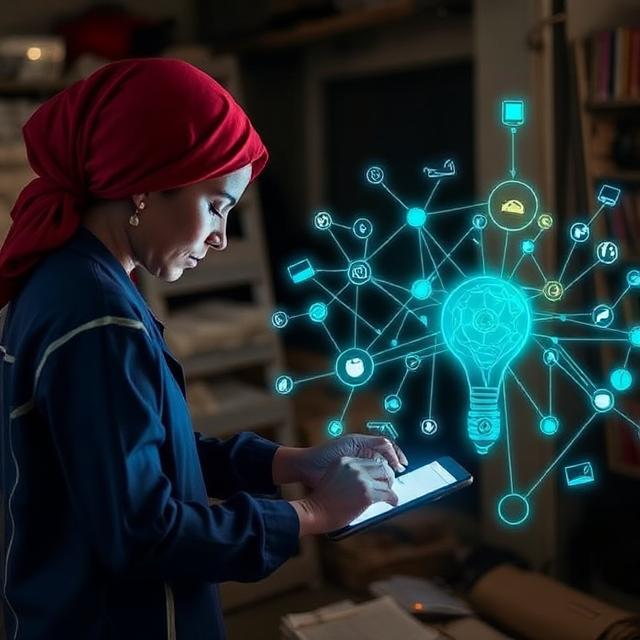
The narrative of Artificial Intelligence (AI) is often dominated by automation and job displacement. However, in the context of India’s informal sector—which employs nearly 90% of our workforce—AI is emerging as the ultimate tool for inclusion, identity, and income security.
At Vayam, we believe that technology only transforms lives when it is built on a foundation of rigorous technical oversight and person-independent systems. As we look toward 2026, AI is no longer a “future concept”; it is the digital infrastructure empowering the backbone of our economy.
1. Bridging the “Identity Gap”
For millions of informal workers—from construction laborers to street vendors—the biggest hurdle to growth is the lack of a verifiable professional history.
- The AI Solution: Generative AI and blockchain are now being used to create Digital Skill Passports. By analyzing work patterns and peer-to-peer validations, AI helps workers build a “reputation score” that banks and formal employers can trust.
- The Vayam Edge: We ensure these data systems are robust. Our Technical Oversight Protocols ensure that even as the “tech” evolves, the data integrity and ethical frameworks protecting worker privacy remain constant.
2. Breaking the Language Barrier with Voice-AI
Digital literacy shouldn’t be a prerequisite for economic opportunity.
- The Innovation: Through platforms like Bhashini, AI now allows a weaver in Odisha or a farmer in Bihar to access market prices, government schemes, and technical training using simple voice commands in their mother tongue.
- Impact: This “Voice-First” revolution is turning the smartphone into a personalized business consultant for the under-served.
3. Augmenting Skills, Not Replacing People
AI in 2026 is about Augmentation.
- Micro-Entrepreneurs: Rural women in Self-Help Groups (SHGs) are using AI-driven design tools to predict urban fashion trends, ensuring their handcrafted products meet market demand.
- Safety & Efficiency: In hazardous informal roles, AI-enabled wearables monitor worker health and environmental risks, providing a layer of protection that was previously non-existent.
4. Sustainability Through Systemic Continuity
The greatest risk in deploying AI for rural livelihoods is “systemic fragility”—what happens when the experts leave?
At Vayam, we mitigate this through our Continuity Mechanisms. Whether we are implementing an AI-driven crop advisory or a digital ledger for an SHG, we ensure:
- Modular Roles: Responsibilities are transferable, ensuring the project outlives its initial architects.
- Standardized Scripts: All technical workflows are documented and reproducible, as per our Standard Operating Procedures.
Conclusion: A Future Built on Trust
AI for livelihoods is not just about “smart code”; it’s about smart systems. By combining cutting-edge technology with Vayam’s commitment to stable, documented, and community-led oversight, we are ensuring that India’s informal workers don’t just survive the digital age—they lead it