
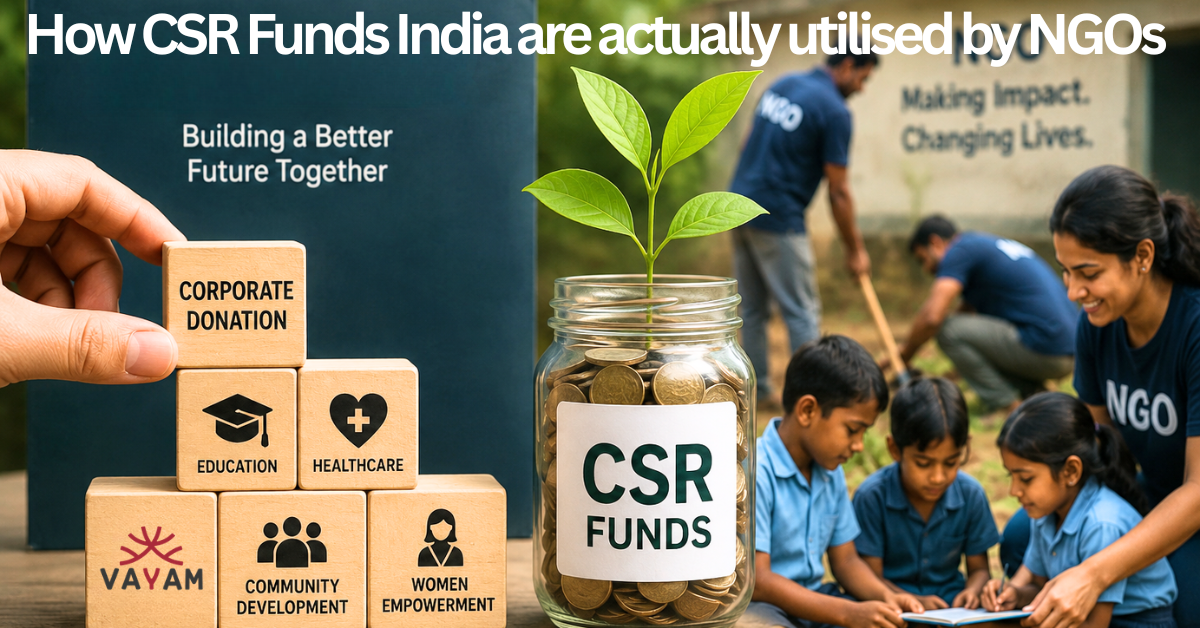
Every year, Indian corporations set aside crores of rupees for social good; a legal obligation under the Companies Act since 2013, but increasingly also a genuine strategic priority. Yet for most people outside the CSR and nonprofit ecosystem, the actual journey of this money remains a mystery. Where does it go after a company writes the check? Who decides which project will get funded? And how much of it will actually reach the people it’s meant to help?
Understanding CSR funds India requires looking past the numbers in headlines and also into how corporates, NGOs, and regulators interact once the money leaves a company’s balance sheet.
The Scale of CSR Funds India Today
The data indicates explosive growth. According to one industry publication, CSR expenditures by Indian businesses hit all-time highs in FY 2024-25, with total spending reaching about ₹40,794 crores, which is a 17% rise compared to the previous year and is part of a cumulative ₹2.61 lakh crore spending that has been accruing over twenty years. In isolation, the expenditures of NSE-listed companies rose by over 23% from ₹18,034 crores in the previous fiscal year to ₹22,212 crores.
This surge is not new; it is part of a decade-long trend. In the past ten years, CSR spending has been rising threefold from small numbers in the mid-2010s to the latest heights. What is different today is the uses of these funds and the companies implementing them in the real world.
Where CSR Activities in India Actually Concentrate
Not all causes get an equal share of CSR in India. Data from the Ministry of Corporate Affairs shows that education and healthcare together account for the lion’s share of total spending historically, around 55% of all CSR expenditure, up sharply from about 44% a decade earlier. Education alone has consistently been the single largest recipient, at times accounting for over 30-35% of total CSR outlay in a given year.
Rural development, by contrast, tells a more uneven story. Despite being one of the earliest and most visible categories of corporate social responsibility India, its share of total funding has been shrinking from roughly 10% of total spend a few years ago to closer to 6-7% more recently, even as the absolute rupee figure has grown alongside overall CSR budgets.
This phenomenon is geo-located as well. Most CSR practices of India are concentrated in six states. Corporate headquarters and places of production are situated there. For example, Maharashtra was the leading state in CSR expenditures with over ₹5000 crores in a previous year. At the same time, Aspirational Districts (those in need of assistance) account for less than 4% of total CSR funds, as stated by the researchers and regulators.
How the Money Actually Moves — Company to NGO to Ground
Here’s where the mechanics of CSR funds India become genuinely interesting. Roughly half of all CSR implementation happens not directly by companies themselves, but through partnerships with nonprofit organisations. A company identifies a cause area aligned with its CSR policy, selects an implementing NGO (often one already working in that space), and transfers funds against a defined project scope, usually with reporting milestones, third-party audits, and impact assessments built into the arrangement.
The model of partnership has transformed the nature of the relationship on both ends. NGOs have been forced to use more rigorous reporting analytics in order to comply with corporate requirements, whereas corporations have benefited from having access to networking and implementation skills of NGOs that are usually absent from corporate CSR departments. A classic example of this model of partnership is a multi-year educational collaboration between a corporate sponsor of the project and a grassroots NGO operating in rural Maharashtra, which led to a rise in school attendance from 65% to 90% and improvements in test scores that would have been impossible to achieve without the surroundings on the ground.
The Compliance Layer Behind CSR Funds India
Corporate social responsibility in India doesn’t run on goodwill alone; it runs on a fairly strict compliance framework. Companies above a certain profit threshold are legally required to spend at least 2% of their average net profits on CSR activities, and any shortfall must either be justified in board reports or transferred to designated Unspent CSR Accounts for future use. In one recent year, listed companies were required to spend roughly ₹22,732 crore but spent slightly less, with the shortfall funnelled into these unspent accounts rather than lost altogether.
For NGOs, this compliance layer matters enormously. To legally receive CSR contributions, an organisation typically needs CSR-1 registration with the Ministry of Corporate Affairs, in addition to standard 80G and 12A tax-exemption certifications. This registration requirement has, in effect, created a filtering mechanism pushing CSR in India funding toward organisations that meet a baseline standard of legal and financial accountability, at least on paper.
Where the System Still Falls Short
Despite tighter compliance on paper, gaps remain in how effectively CSR funds in India reach the communities that need them most. Several patterns show up consistently in sector analysis:
- Sectoral imbalance: Education and healthcare dominate, while equally critical areas like livelihood enhancement, mental health, and urban poverty remain comparatively underfunded; one analysis pegged livelihood enhancement spending at under ₹2,000 crore against far greater need.
- Geographic skew: CSR activities in India cluster near corporate hubs due to the “local area preference” clause in the Companies Act, often at the expense of remote or rural districts that need support more urgently.
- Declining rural allocation: Even as total CSR budgets have grown, the proportional share going toward rural development, sanitation, and poverty alleviation has fallen over the past several years.
- Measurement gaps: Not every CSR-funded project comes with rigorous third-party impact assessment, making it hard for donors and the public to verify whether reported outcomes reflect real, lasting change.
Why This Matters for Donors and Companies Alike
For companies evaluating where to direct their CSR budgets, and for individual donors trying to understand how corporate philanthropy actually functions, the throughline is the same: money alone doesn’t create impact; implementation does. The NGOs that tend to make the most of csr funds India are the ones that combine financial transparency with measurable, third-party-verifiable outcomes, not just activity reports.
Looking Ahead
Industry projections suggest India’s total CSR spending could nearly triple again by the mid-2030s, reaching well over ₹1 lakh crore annually. That scale of funding represents a genuine opportunity to close persistent gaps in rural development, healthcare access, and education, but only if the imbalances in sector allocation and geographic distribution are actively addressed, rather than left to compound.
Corporate social responsibility india has clearly moved past being a compliance checkbox. The next phase of its evolution will likely be judged not by how much money is spent, but by how transparently that money is tracked, and how directly it reaches the communities the law was originally designed to support.