
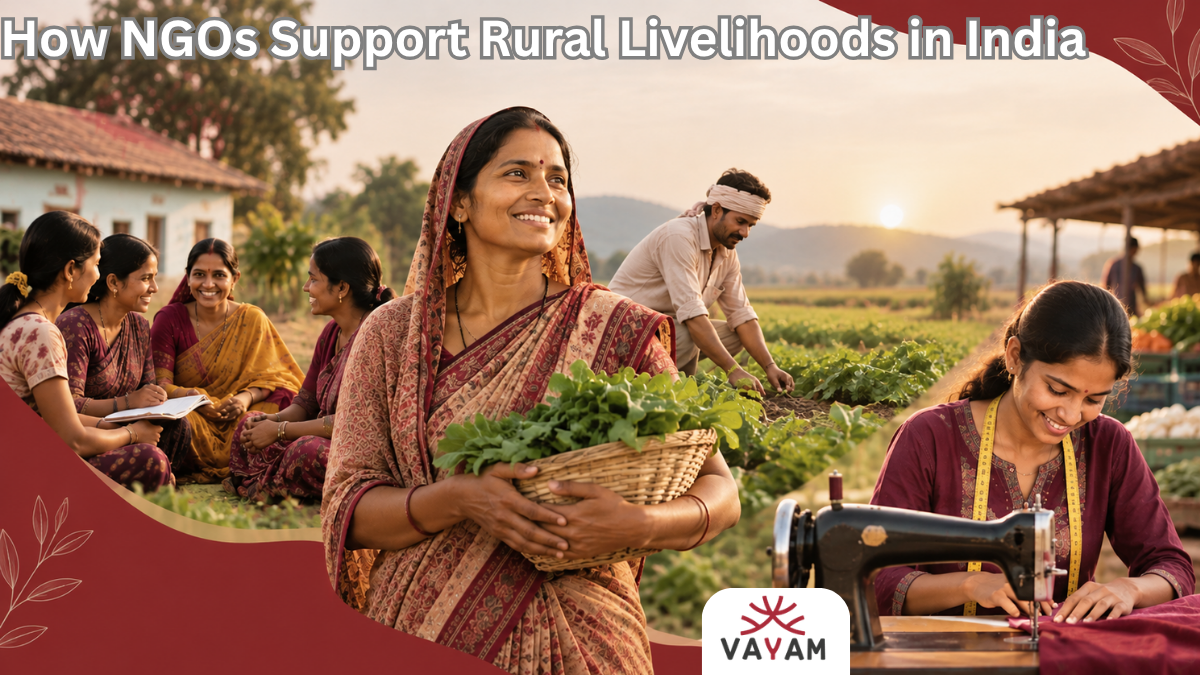
The rural economy of India is the backbone of the country, with around 65% of the population living in rural areas. However, rural communities continue to face challenges such as limited market access, underdeveloped infrastructure, lower literacy rates, and dependence on uncertain agricultural income. This is where NGOs Supporting Rural Livelihoods in India play a crucial role in bridging these gaps and creating sustainable opportunities.
This blog explores how NGOs contribute to rural livelihood development and why their presence in rural communities is essential for inclusive growth and long-term development.
Understanding the Rural Livelihood Challenge
In order to explore solutions to the existing issues, it would be worthwhile to grasp the nature of the problems. The Indian agrarian society has a huge majority of the population engaged in agricultural activities that provide them with seasonal income that depends on rain and little else. Also, aside from agriculture, income generation is almost impossible due to:
- Gender imbalances and women’s lack of economic presence
- Low access to formal education and vocational training
- Low levels of financial inclusion
- Poor integration of local products into the market
- Youth workers migrate from rural areas to cities looking for jobs
As a result, these problems create a vicious cycle which can hardly be broken without specific actions undertaken by NGOs operating in this sphere.
Key Ways NGOs Support Rural Livelihoods in India
Skill Development and Vocational Training
The training programs for rural youth and adults provided by NGOs rank among the most important contributions made by these organizations. The courses offered cover areas such as tailoring, handicrafts, food processing, carpentry, electrical work, and digital literacy. As a result, individuals who complete these courses can adequately earn a decent income. Unlike schools or colleges, these programs are created based on local market demand; therefore, students are taught practical skills that can be immediately utilized upon graduation. Initiatives such as the Skill India Digital Hub also provide access to skill development and vocational learning opportunities.
Promoting Self-Help Groups (SHGs)
Another successful model of rural livelihood improvement supported by NGOs is the establishment of Self-Help Groups (SHGs). The NABARD Self-Help Group–Bank Linkage Programme has also played an important role in connecting SHGs with formal banking services.
NGOs assist in the creation of these groups, which help their members save money and access micro-loans to invest in small-scale businesses, including dairy farms and tailoring businesses. This model is beneficial not only in terms of income generation but also in the development of financial awareness among rural women who previously did not take part in any economic decision-making.
Agricultural Support and Modern Farming Techniques
As farming is considered the predominant source of livelihood in a majority of villages, non-governmental organizations are implementing new technologies in agriculture. For instance, NGOs provide assistance to farmers through training and advising in organic cultivation, irrigation systems such as drip irrigation, crop rotation, and sustainable land management. This practice involves enabling farmers to use good agricultural practices such as sowing improved seeds, performing soil tests, and applying techniques that increase resistance to climate change, thereby leading to more crops produced and reduced anxiety regarding unpredictable weather; thus improving household welfare.
Market Linkages and Access to Fair Trade
However, the process of production is only one half of the problem since the product must be sold as well and at a reasonable price. Many NGOs are engaged in helping the rural population in entering markets, e-commerce platforms, and big businesses, thus eliminating intermediaries. As a result, rural workers get reasonable income due to the elimination of exploitative middlemen, this applies to both handmade cloth and agricultural production.
Financial Inclusion and Microfinance
Unfortunately, access to banking services is far from being satisfactory in rural areas. Many NGOs provide assistance in increasing the level of financial literacy as well as opening bank accounts and lending programs for that matter.
Women’s Empowerment Through Entrepreneurship
A key objective of rural livelihood improvement programs is to promote women entrepreneurship. Nonprofit organizations start providing financial support and training as well as assisting women business owners in marketing business. This way, women become diversified income providers and dissolve traditional gender roles, thus influencing the status of women in society.
Infrastructure and Resource Development
Rural development organizations work not only on skills training. They invest into energy supply and social programs such as clean water supply and completion of sanitary facilities. With reliable infrastructure in place, local people do not waste time on basic needs, and they can develop income sources or get education.
Digital Literacy and Technology Adoption
In the modern digital age, rural NGO help communities with technology. They provide training in operating smart devices, digital payments, and general issues of e-commerce.
The Role of Vayam in Strengthening Rural Livelihoods
Organizations such as Vayam lead the movement by collaborating with rural communities to create solutions that are tailored to their needs instead of general programs. These organizations aim to develop sustainability by combining financial inclusion, skill-building, and agricultural practices that are environmentally friendly. The idea here is to overcome the dependency of people on government money.
Why This Work Matters
One of the important advantages of boosting rural livelihoods is that when rural economies are successful, the effects of that can be noticed at the national level.
- Migration becomes reduced as people do not look for jobs in overcrowded cities
- Having enough funds for an adequate living, children have more chances to attain education
- Local economies become less susceptible to changes taking place in foreign markets.
This ripple effect demonstrates why sustainable rural livelihood development isn’t just a social cause—it’s an economic necessity for India’s continued growth.
Challenges NGOs Face in This Mission
The repercussions are indeed considerable, but NGOs engaged in this field encounter particular difficulties:
- There are constraints regarding funding and availability of other resources.
- Difficulties arise in trying to replicate successful pilot programs in other regions.
- The changing of norms faces resistance in very conservative communities.
- Measuring long-term impact as opposed to short-term results is problematic.
Despite these challenges, the sector continues to innovate, using data-driven approaches and community-led models to maximize impact with limited resources.
The Path Forward
The success of rural livelihoods development in India is connected to the cooperation of various actors involved in the process, including NGOs, governmental agencies, corporate players, and local communities. Partnerships based on public-private principles, responsible business initiatives, and technological solutions can considerably enhance the efficiency and quality of grassroots efforts. The growing consensus around the idea that it is worth investing in India’s rural sector implies that new possibilities for effective, beneficial transformation of the entire region are arising.
Conclusion
The efforts of NGOs in rural areas have proven time and again that meaningful, community-driven interventions can transform lives. From skill development and financial inclusion to market access and women’s empowerment, these organizations are creating diverse livelihood opportunities that uplift entire communities. Strengthening rural livelihoods in India isn’t just about alleviating poverty; it’s about building a more equitable, self-sufficient, and resilient nation.
Organizations like Vayam continue to demonstrate that with the right support, training, and resources, rural India has immense potential to thrive. As we move forward, sustained investment and collaboration will be key to ensuring that no village is left behind in India’s journey toward inclusive development.