
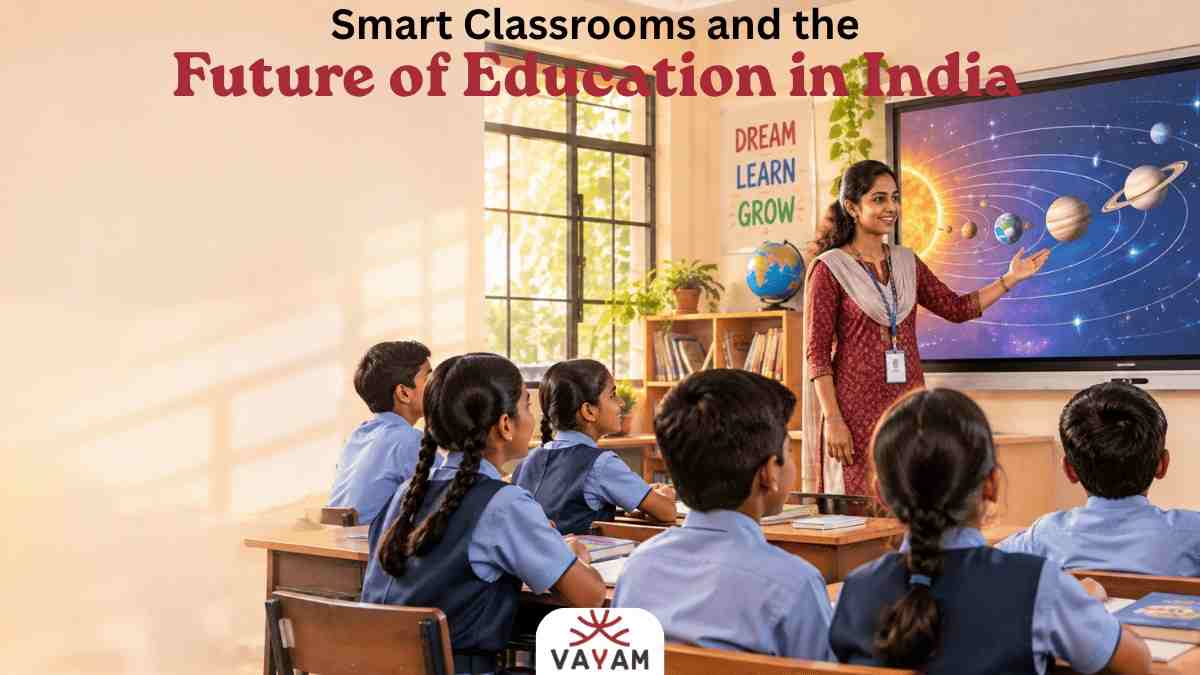
If you enter a classroom today, you will see more than just a blackboard and books. It would rather be a screen showing a video lesson, a teacher using PowerPoint, or students passing an online examination. This is one of the ways modern technologies penetrate the education industry.
Hence, we get an idea of smart classrooms in India. Nevertheless, a smart classroom is not merely a normal classroom with a screen in front of a blackboard. The difference is that technology is used to make learning much simpler.
What Is a Smart Classroom?
A smart classroom is a technology-enabled learning environment that uses digital tools to support teaching and learning. Depending on the school and available resources, a smart classroom may include:
- Interactive digital displays or smart boards
- Projectors and audio-visual equipment
- Computers, tablets, or other digital devices
- Educational videos and animations
- Digital learning platforms
- Internet-enabled learning resources
- Interactive quizzes and assessments
- Digital educational content
The aim is not just to bring new technologies; they are meant to aid teachers and facilitate school students in acquiring knowledge. For instance, while learning about the solar system, students may move beyond working with textbooks and instead utilize animations, interactive models, videos, and illustrations.
Why Are Smart Classrooms in India Important?
India is home to one of the largest school-age populations in the world and offers diverse educational environments to its students. Some children get access to digital tools, others struggle in lack of educational supplies and facilities including limited access to modern technology. Thus, it is important to see the expansion of smart classrooms in India as both an opportunity and a challenge. A smart classroom can help schools:
- Implement more diverse learning materials
- Represent complex concepts in a more graphical manner
- Promote student participation
- Give access to digital educational resources
- Cater to different learning styles
- Develop digital literacy
- Enhance traditional classroom education.
But still, it is impossible to overcome all educational problems only with the help of technology. Effectiveness of technology depends on how properly it is integrated into the educational process and whether teachers and students are provided with necessary support in the use of technology.
Key Smart Classroom Benefits in India
1. Makes Learning More Interactive
The concept of traditional teaching style is often thought of as one that is mostly based on lectures and written materials. Technological tools used in classrooms make it easier for teachers to use animated programs, videos, diagrams, simulations, and other interactive content.
Thus, the lessons become more interesting and dynamic, which helps engage students actively.
2. Simplifies Complex Concepts
Some subjects are not very easy to teach as they require visual explanation. Visual interpretation is especially effective for teaching subjects such as science, geography, mathematics, and so on. To make it easier for their pupils to understand such topics as the water cycle, teachers can choose visual data such as animated presentations.
Visual learning is useful for explaining complicated and abstract concepts.
3. Provides Access to Diverse Learning Resources
Digital learning is another way of connecting students with learning materials that are not accessible in a particular school. The modern learning techniques allow teachers to utilize various digital presentations, educational videos, materials from the Internet, simulations, and other related materials in addition to traditional textbooks.
This approach may be beneficial in situations when access to typical textbooks is limited.
4. Encourages Student Participation
Interactive exercises can enable students to actively engage in their studies. Digital questionnaires, games, problem-solving activities, and interactive games may help enrich the experience of learning. Students will not be passive receivers of information anymore and will be able to process information better.
5. Supports Different Learning Styles
Not all students learn in the same manner. Some students understand better through illustrations and images, while others learn better through demonstrations, multimedia, or interactive games. Smart classrooms enable instructors to present an idea via various means, thereby creating a more diverse learning environment.
6. Develops Digital Literacy
Not only does learning today mean academic learning but also the ability of a learner to utilize advanced technology in everyday life. Rapport with modern devices can be developed when technology is available to learners within a controlled environment.
Smart Classrooms in India and Rural Education
When discussing the importance of smart classrooms within the context of rural and disadvantaged populations, their capability to be beneficial becomes especially evident. Rural students might experience obstacles when it comes to learning materials, connectivity, infrastructure, and high-quality educational opportunities. Nevertheless, technology can help fill the gaps by letting teachers use more educational materials in their classes. Creating a truly effective smart classroom requires more than simply setting up a display.
The success of implementing a smart classroom depends on:
- Having reliable electricity
- Ensuring digital infrastructure is at hand
- Making sure the Internet connection is provided whenever necessary
- Educating teachers on technology application
- Using related and available content
- Providing regular maintenance and technical support
- Making sure that students have access to technology and get to use it. Without support, technology will not be used.
This is one of the reasons why it is crucial to consider digital inclusion along with digital education.
The Role of Teachers in a Smart Classroom
There are some functions that technology cannot perform in place of a teacher. To be more specific, a teacher remains an integral part of the process of education as they can read their students and identify the gaps in their understanding while technology cannot. In smart education, instead of being a source of information, a teacher acts as a facilitator of education.
For example, a teacher introduces a topic through a video, examines the understanding of the topic through a hands-on task, and continues with a discussion, where students connect the content of the class to real-life situations.
Technology is a means while the teacher governs the process.
Smart Classroom vs Traditional Classroom
The difference between a traditional classroom and a smart classroom is not simply the presence of technology.
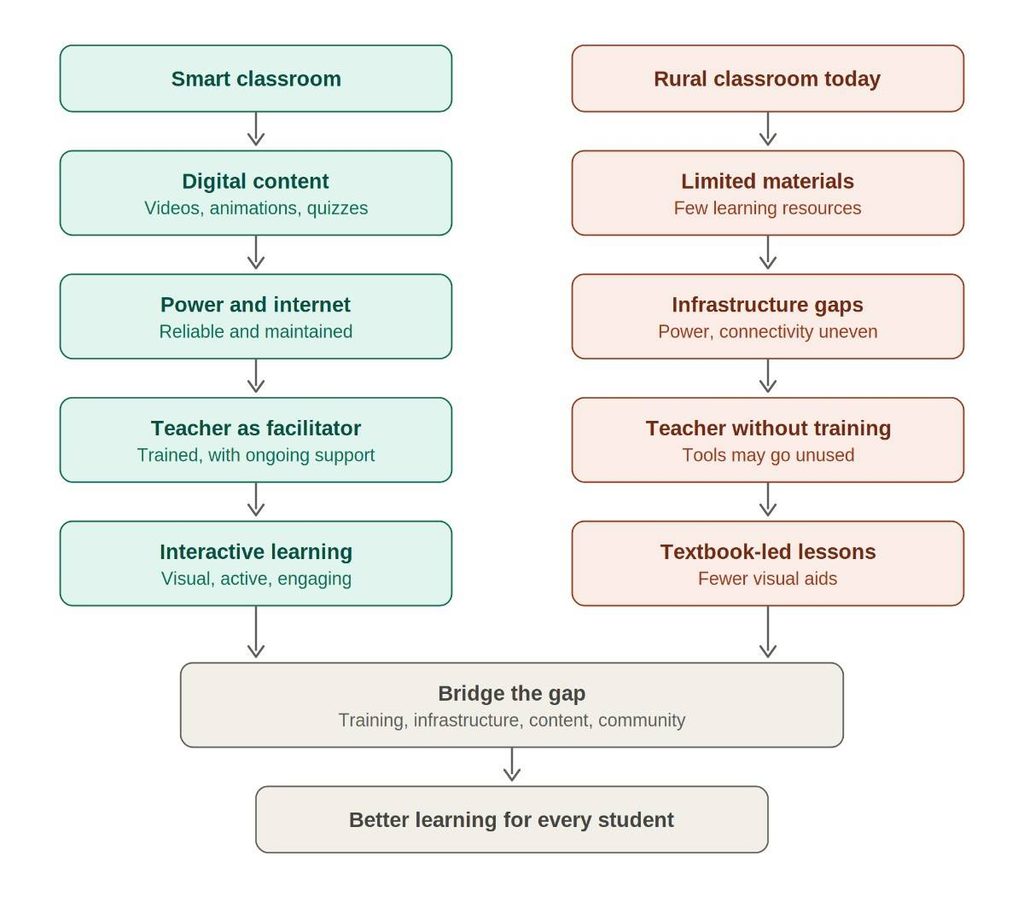
A smart classroom should therefore be viewed as an extension of effective teaching, rather than a replacement for traditional educational practices.
Challenges in Implementing Smart Classrooms in India
Despite their potential, smart classrooms also come with challenges.
Infrastructure Gaps
Technology requires supporting infrastructure. Electricity, internet connectivity, devices, and appropriate classroom facilities can be difficult to provide consistently in some locations.
Teacher Training
Providing technology without training can limit its usefulness. Teachers need practical training to understand how digital tools can improve their existing teaching methods.
Digital Divide
This implies that schools should not assume that every pupil can carry on with online education after lessons.
Maintenance
Machines may break down, need improvements, or become obsolete. A high-tech classroom would thus require action regarding repairs, maintenance, and future needs.
Quality of Content
Not every material that can be found online is suitable for learners. Digital content needs to be true, suitable for the student’s age, clear, and appropriate for lessons.
How Can Smart Classrooms Become More Effective?
For smart classrooms to create meaningful educational outcomes, implementation should focus on people as much as technology.
1. Train Teachers
Teachers should receive hands-on training and continuous support rather than one-time demonstrations.
2. Focus on Learning Outcomes
Technology should be introduced because it solves a learning problem or improves an existing teaching approach.
3. Prioritize Accessibility
Digital learning solutions should consider students with different learning needs and students with limited access to technology outside school.
4. Involve the Community
Schools, teachers, parents, local communities, and implementation partners can work together to ensure that technology remains useful and sustainable.
5. Measure Impact
Smart classroom initiatives should evaluate whether students are actually learning better. Useful indicators can include attendance, participation, comprehension, learning outcomes, teacher adoption, and student engagement.
The Future of Smart Classrooms in India
The future of education is unlikely to be purely traditional or purely digital. An innovative approach to education could be a combination of both traditional classrooms and modern technologies.
Various technological advancements, including but not limited to AI, personalized learning technologies, virtual simulations, etc., could significantly improve education processes in the future. But still, the essence of education must remain the same – the new education should help students learn better than before.
Hence, smart classrooms should not be evaluated in terms of the number of screens in the school, but in the degree of efficiency they help students achieve through studying, learning, acting, and succeeding.
Building a More Inclusive Digital Future
For smart classrooms to contribute meaningfully to India’s education system, access to technology needs to go hand in hand with teacher capacity, infrastructure, relevant content, and community involvement.
This is especially important for rural education. It should not be mandatory for the students to be in the city for a good learning experience. Digital education in itself should not imply the absence of human relationships that characterize a real classroom.
It is reasonable to think that the best solution is where teachers, students, community, and technology interact with each other.
Conclusion
The development of smart classrooms in India mirrors the ongoing transformation taking place in the educational sphere. The advantages of the smart classroom range from visually appealing lessons and interactive learning processes to better access to educational materials. However, technology alone is incapable of changing education.
The digital classroom requires trained teachers, infrastructure that is in good condition, proper content, and, most importantly, an understanding of the learning process. In India, as digital communication technologies develop, smart classrooms can also help create the right learning opportunities.
The classroom of the future does not need to choose between traditional education and the use of technologies. They can combine both approaches.