Before you donate or fund, verify NGO 80G registration first. A few quick minutes on official portals can protect your money and confirm that your tax benefit is genuine.
The reality is that there are thousands of NGOs functioning in India who are doing authentic and admirable work. However, there are also some fake or dormant NGOs that seek donations from willing donors. Whether you are an individual donor looking for the possibility of tax deductions on your donations or a corporate entity planning to fund an NGO under CSR norms, a basic check will help you find out whether the NGO in question is a registered one. This guide will take you through 80G and CSR-1 and also explain to you how to check for them.
What Is 80G Registration?
80G is a certification offered by the Income Tax Department of the Government of India that allows donors to deduct any donations made to the NGO from taxes. Depending on the NGO’s approval granted by the authorities, taxpayers can claim either 50% or 100% tax deduction on their contributions to the NGO. However, in case the NGO does not have 80G certification, then the taxpayers may not be able to get any deduction for their donations.
Normally, an NGO needs to have a 12A registration (which allows it to become tax-exempt) before being eligible for the 80G certification. Therefore, it is advisable to check if the NGO has been registered under 12A before you check its 80G certification.
It is important to note about the new law in respect of the Income Tax Act of 2025 that came into effect from April 1, 2026.
A note on the new tax law: The Income-tax Act, 2025 came into effect on 1 April 2026, and the older 12A and 80G provisions now sit under new section numbers. In everyday use, though, NGOs and donors still call it “80G”, and you will see that name on most certificates and receipts.
What Is CSR-1 Registration?
CSR-1 is a registration document that is submitted on the MCA portal. As of 01 April 2021, any NGO that wishes to obtain CSR funds must submit CSR-1. A trust, society, or Section 8 company can register. Once CSR-1 is approved, the NGO receives a unique CSR Registration Number.
CSR-1 is mainly of importance for companies and CSR teams because it establishes that the NGO has been registered as an eligible implementing agency. An individual donor does not need to check CSR-1, although it can be a sign of a good NGO. If you want to understand the process from the NGO’s side, read our guide on how to apply online for CSR funding.
How to Verify an NGO’s 80G Registration
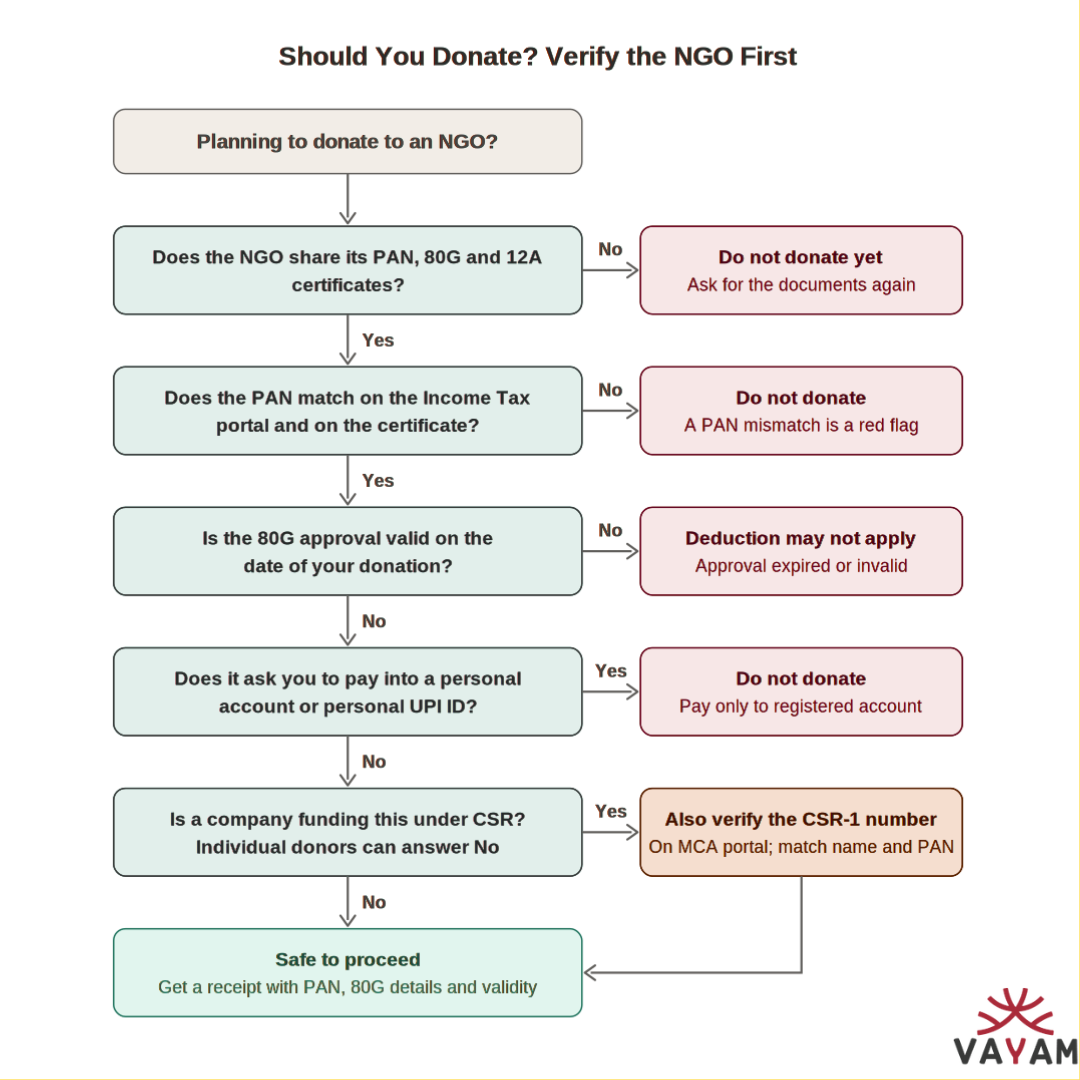
- Request information. Ask for the NGO’s PAN, 80G certificate and 12A certificate.
- Look for the information online. Use the Income Tax Department e-filing portal (incometax.gov.in) and look for tax-exempt institutions search. You can find it by searching with NGO name or PAN.
- Confirm the PAN number. The PAN on the online portal should be same as the PAN shown in certificate and mentioned in receipt.
- Verify the information. Make sure the approved documents are still valid by the time you make the donation.
- Verify the 12A status as well. Valid 12A is good in combination with 80G.
How to Verify an NGO’s CSR-1 Registration
- Inquire about the CSR Registration number. Only genuine NGOs that avail of CSR funding will have them.
- Ask for the CSR-1 filing acknowledgment available on the MCA portal.
- Verify that the details match. The name, registration number, and PAN of the NGO on the CSR-1 must be the same as in our 12A and 80G documents.
- Check the MCA portal (mca.gov.in). The CSR section of the portal is the authentic source of CSR-1 information.
- Look for other supporting registrations. Many authentic NGOs also belong to NGO Darpan and the National CSR Exchanges. These extraneous confirmations can help but do not serve as substitutes for MCA registration.
Other Checks Before You Give
- NGO Darpan ID: Verify the NGO on ngodarpan.gov.in.
- FCRA registration: If the NGO receives foreign funds, check its FCRA status.
- Annual reports and audited accounts: Real NGOs share these openly.
- Past work and projects: Look for photos, impact stories and local partners. You can see an example of how we explain our programs in our blog on how NGOs support rural livelihoods in India.
- Payment method: Pay only to the NGO’s registered bank account, never to a personal account or personal UPI ID.
- Proper receipt: The receipt should show the NGO’s name, PAN, 80G approval details and validity period.
Red Flags to Watch For
- The NGO fails or refuses to provide its registration details.
- The registration number or name on the donation receipt does not correspond.
- It requests the donation to be made to a personal bank account.
- It puts pressure on the donor to give money immediately.
- The documents are suspiciously old, modified or outdated.
- It promises tax benefit without showing any evidence.
If you doubt anything, stop and verify. Authentic NGOs have no issues answering your queries.
Conclusion
Verify an NGO 80G registration status enables you to safely donate your money and put a tax claim. Validating CSR-1 will give organizations confidence that their CSR contributions will be properly implemented. Request documentation, match it with official sources, and transfer funds only to registered bank accounts.