
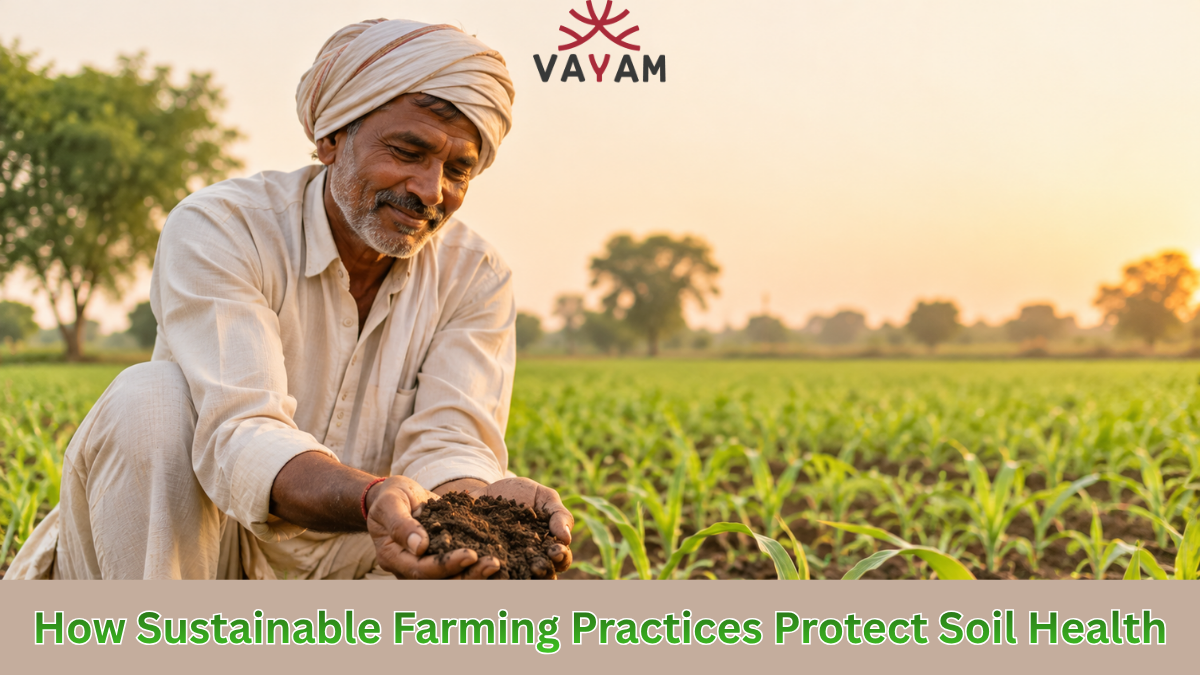
Good soil is the foundation of any farm. It nourishes our crops, cushions us from flooding, stores carbon, and supports thousands of microscopic organisms. But decades of heavy chemical use, monocultures, and ploughing over the last century have left most of India’s land increasingly eroded and increasingly sterile. Sustainable agriculture offers a way to turn this around and keep the small farmers on the land.In the following article, we’ll read about How Sustainable Farming Practices Protect Soil Health.
Why soil health matters
The soil is a living thing. In this living system, organic matter, microbes, earthworms and nutrients determine the productivity of a crop. Poor soil health means higher fertilizer use, lower water retention and less resilient land to droughts and storms for farmers. Soil health is not just about the environment. It is also about livelihood.
Key sustainable farming practices that protect soil health
- Crop Rotation: The crop is supplied by crop rotation so no depletion of soil occurs. The nut and pulse crops are alternated with cereal crops to break the pest and disease cycle and nitrogen is deposited into the soil.
- Cover crops, crop residues, or mulches offer a cover that has the potential to protect the soil from erosion by rain and wind. Cover also has the potential to minimize evaporation loss of moisture and weeds while decomposing to add finished organic material.
- No tillage/ Reduced tillage. Soil tillage practice requires excessive and deep plowing of the soil that can disrupt the soil structure and remove carbon deposits. Minimum tillage eliminates this problem and ensures the health of the soil at the same time.
- Organic carbon restoration is possible due to the use of vermicompost, compost, and animal dung.
- IPM (Integrated Pest Management). IPM not spray chemicals all the time, instead using biological control, trap crops and only treats when necessary in order to not kill all the life in the soil and not have to shell out a lot of money.
- Excellent water management. The use of farm ponds, rainwater harvesting and drip irrigation avoids waterlogging, drainage and salinity. Effective water management is an essential part of climate-smart agriculture in dry areas and weather-based rain-fed crop production.
- Agroforestry and inter-cropping. Trees and mixed cropping protect soil with their roots, give shade, organic matter and fodder, and generate additional income for farmers from their fruits, fodder or timber.
The benefits for farmers and rural communities
- Higher, more stable yields as soil fertility improves over time
- Lower input costs from reduced dependence on chemical fertilizers and pesticides
- Better water retention that helps crops survive dry spells
- Reduced soil erosion and land degradation
- Increased climate resilience to unpredictable rainfall and heat
- Better food and safer jobs for farm families
The benefits all stack up. Healthy soils lead to healthier farmers, because they cost less, earn more and are more resilient in difficult years.
Why farmers need support to make the shift
Implementing regenerative agriculture and sustainable techniques is seldom a quick process. Outcomes may sometimes take several seasons, due to some farmers worrying that they might not get paid during this period. Furthermore, many farmers lack access to soil sampling, knowledge, good seeds, and fair markets for organic produce.
The role of local community organizations is vital in this context. In India, organizations like Vayam promote education among local communities via farmer education programs, training sessions, women self-help programs, and knowledge exchange. When farmers learn from other farmers and start seeing results in their neighbours’ fields, they understand the benefits of using better practices quickly.
Simple first steps for farmers
- Get the soil tested to know its nutrient status and organic carbon level.
- Start small. Try one practice, such as mulching or composting, on a small plot.
- Add a legume to the crop cycle.
- Stop burning crop residue. Use it as mulch or compost instead.
- Learn together. Join farmer groups and training sessions to share experiences.
Final thoughts
Sustainable farming seeks to preserve and enhance the land on which we live. In sustainable farming, farmers utilize practices that help with soil preservation, such as crop rotation, composting, reduced tillage, cover cropping, and conservation measures to increase farming sustainability.
1. What is soil health, and why does it matter for farmers?
Soil health means how well the soil can support crops, retain water, and sustain living organisms like microbes and earthworms. It matters because healthy soil gives steadier yields with fewer inputs. Poor soil means higher fertilizer costs, weaker crops and less protection against drought.
2. Which sustainable farming practices protect soil health the most?
Crop rotation, cover crops and mulching, reduced tillage, composting, integrated pest management, good water management and agroforestry all help. No single practice works everywhere, so most farmers see the best results by combining two or three that suit their land and climate.
3. How long does it take to see results from sustainable farming?
This varies by soil, climate and practice. Some benefits, like better moisture retention under mulch, can show up within a season. Improvements in soil structure and fertility usually take several seasons, which is why starting small and staying consistent works better than expecting quick change.
4. Is sustainable farming profitable for small farmers?
It can be. Lower spending on chemical fertilizers and pesticides cuts costs, and healthier soil tends to give more stable yields over time. The early years can be tight, though, so support from training, soil testing and fair market access makes a real difference.
5. How can a farmer test soil health?
Collect samples from the field and send them to a soil testing laboratory. The report shows nutrient levels, pH and organic carbon, so you know what the soil needs. Farmers can ask at their nearest Krishi Vigyan Kendra or agriculture department about testing facilities and government schemes like the Soil Health Card.
6. Why is burning crop residue bad for soil?
Burning destroys organic matter and kills useful microbes near the surface, and it adds to air pollution. Using the residue as mulch or compost returns nutrients to the soil, holds moisture and builds organic carbon instead of losing it.
7. Where should a farmer start if they want to farm more sustainably?
Start small. Get the soil tested, try one practice like mulching or composting on a small plot, and add a legume to the crop cycle. Joining a local farmer group helps too, since seeing results in a neighbour’s field is often what builds confidence.