
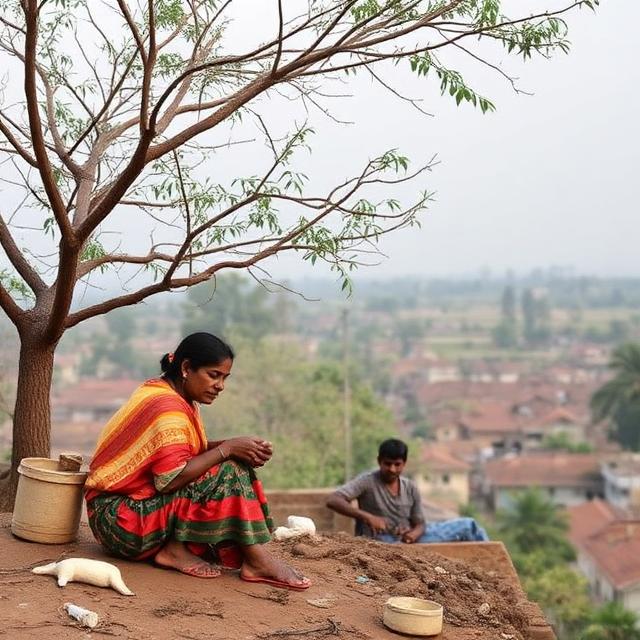
In 2026, the term “climate change” has ceased to be a distant threat for India; it is a daily reality of 50°C heatwaves in the Deccan and flash floods in the Himalayas. For the millions of informal workers and smallholder farmers, the challenge is no longer just “mitigation”—it is survival.
At Vayam, we are harnessing AI as a protective shield, turning complex climate data into a form of “digital insurance” for those at the front lines of a warming planet.
1. “Plan, Not Panic”: The Rise of BharatFS
Launched in 2025 and scaled significantly this year, the Bharat Forecasting System (BharatFS) represents a leap in hyper-local climate intelligence.
- The Granularity Shift: Moving from 12 km to 6 km resolution, AI models now provide weather forecasts at the individual village level.
- The Human Impact: This precision allows a marginal farmer to receive a 10-day advance warning on rainfall, specifically tailored to their khet (field). Instead of losing a harvest to a sudden downpour, they have a window to “plan, not panic.”
2. Early Warning Systems (EWS) for Extreme Events
Traditional warning systems often fail because they lack “lead time.” In 2026, AI is extending that window, saving both lives and livelihoods.
- Landslide Prediction: In the Himalayan regions, indigenous AI models now integrate data from low-cost soil sensors to provide alerts 3 hours before a slope failure with 90% accuracy.
- Cyclone Intensity: The India Meteorological Department (IMD) uses the Advanced Dvorak Technique, an AI-assisted tool that estimates cyclone intensity from satellite imagery, allowing for more surgical evacuation plans in coastal Odisha and Bengal.
- Flood Watch India: New AI-driven platforms like BrahmaSATARK provide impact-based flood forecasts, predicting not just if it will flood, but which specific streets and houses are at risk.
3. Protecting the “Invisible” Laborer: Heatwave AI
For India’s 40 million construction workers and street vendors, heat is a silent killer.
- Predictive Heat Mapping: AI models now cross-reference urban heat island data with worker density.
- The Vayam Goal: We are working on integrating these “Heat Risk Maps” with mobile-first alerts. By predicting a “wet-bulb” temperature spike 48 hours in advance, we can trigger automated advisories to labor contractors to shift work hours or provide mandatory hydration breaks, protecting the dignity and health of the informal workforce.
4. Climate-Smart Agriculture: The Resilience Equation
Resilience in 2026 is built on the Saagu Baagu model—an AI-driven approach to farming that has already doubled the net income for thousands of chili farmers in Telangana.
| Climate Challenge | AI-Enabled Resilience |
| Water Scarcity | Smart Irrigation: AI sensors shut off water when soil moisture is optimal, saving 30% of water. |
| New Pest Migrations | Pest Risk API: Models trained on historical and satellite data alert farmers to “outbreak windows” before they happen. |
| Soil Degradation | BharatVISTAAR: AI-driven advisories recommend regenerative crops that “fix” nitrogen based on specific soil health cards. |
$$E_i = \frac{Y}{W_a}$$
AI optimizes the Water-Use Efficiency ($E_i$) by calculating the ratio between Crop Yield ($Y$) and Water Applied ($W_a$), ensuring every drop contributes to resilience.
The Vayam Ethics: Inclusive Resilience
A “Resilient India” must be inclusive. We ensure that our AI solutions:
- Go Offline: High-resolution data is processed at the “edge” (on the device) to ensure warnings work even when the network fails during a storm.
- Speak Native: All alerts are delivered via Bhashini-powered voice notes in 22+ languages, ensuring that literacy is never a barrier to safety.
- Avoid the “Black Box”: We prioritize transparent models that explain why a certain action—like early harvesting—is being recommended, building long-term trust with tribal and rural communities.
Conclusion: Technology as a Public Good
Climate resilience is not a luxury; it is a fundamental right. By bridging the gap between high-end satellite data and the palm of a laborer’s hand, we are ensuring that India’s progress is not washed away by the next monsoon.