
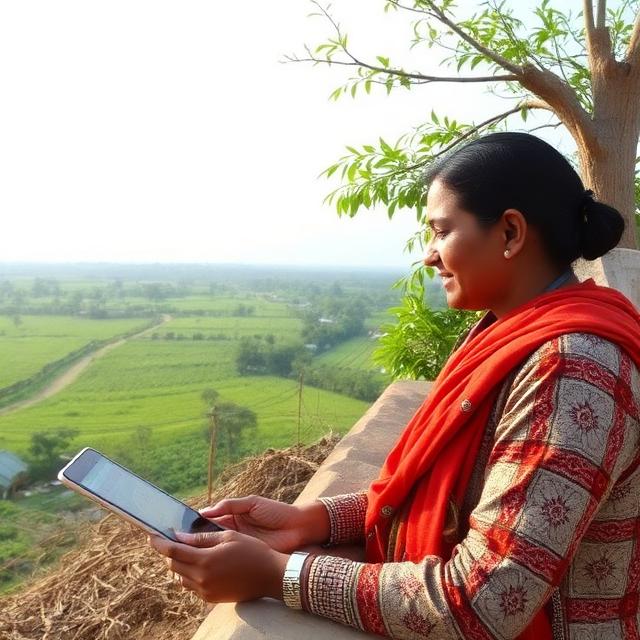
As the India-AI Impact Summit 2026 recently highlighted, the conversation around technology has shifted from “high-tech” to “last-mile tech.” In the heart of rural and tribal India, the digital divide is not just about lack of internet; it is a chasm of language, literacy, and trust.
At Vayam, we believe that bridging this divide isn’t about giving every citizen a smartphone—it’s about ensuring that AI speaks the citizen’s language and respects their heritage.
The New Frontiers of Inclusion: Beyond the Screen
Digital inclusion for tribal communities requires a departure from traditional “app-based” models. Here is how 2026 is redefining access:
1. Adi Vaani: Breaking the Linguistic Silos
For decades, government welfare information was locked in Hindi or English, effectively excluding millions of tribal citizens.
- The AI Intervention: The Adi Vaani platform now provides real-time, voice-based access to governance, healthcare, and education in native tribal dialects.
- Impact: A Gondi-speaking forest dweller can now interact with a multilingual chatbot (TriBoT) to check their forest rights status or health benefits without needing a translator.
2. AI for Land and Forest Rights (FRA)
One of the most significant barriers to dignity for tribal populations is the complex claim process under the Forest Rights Act (FRA).
- The AI Solution: AI-enabled GIS mapping and automated workflow systems are streamlining claim submissions. By analyzing satellite imagery and historical land records, AI helps verify claims with high transparency.
- Impact: Reducing the “human bias” in manual verification ensures that rightful land owners get their digital titles faster and more securely.
Challenges to Overcome: The Responsibility Framework
While the potential is immense, “Responsible AI” must address specific risks unique to tribal regions:
| Challenge | The Vayam Response |
| Data Sovereignty | Tribal data is often culturally sensitive. We advocate for “Digital Sovereignty” where communities control how their linguistic and cultural data is used to train AI. |
| The “Monolith” Myth | AI must recognize that “Rural India” is not a monolith. Models must be trained on heterogeneous data that captures the unique socio-cultural nuances of different tribes. |
| Algorithmic Bias | Without diverse datasets, AI risks reinforcing historical exclusions. We prioritize Human-in-the-Loop verification to ensure machine decisions are culturally appropriate. |
Case Study: JanAI and the Power of Community
The JanAI initiative, unveiled earlier this year, proves that rural youth are ready for this transition. A primary survey found that 55% of rural youth now use AI tools daily—not for entertainment, but for “career-augmenting” tasks.
The “Vayam” Roadmap for Tribal Inclusion:
- Voice-First Everything: Text is a barrier; voice is a bridge.
- Offline-First AI: Many tribal areas remain “shadow zones.” We focus on edge-AI that can process queries locally without high-speed fiber.
- Trust Through Intermediaries: We empower Village Level Entrepreneurs (VLEs) and ASHA workers with AI tools, allowing the technology to be delivered through a trusted human face.
Conclusion: From Digital Access to Digital Opportunity
True digital inclusion is achieved when a tribal artisan or a forest-dwelling family doesn’t need to learn a new language to benefit from the modern world. At Vayam, our goal is to make AI an invisible ally—a tool that preserves heritage while opening doors to the global economy.