
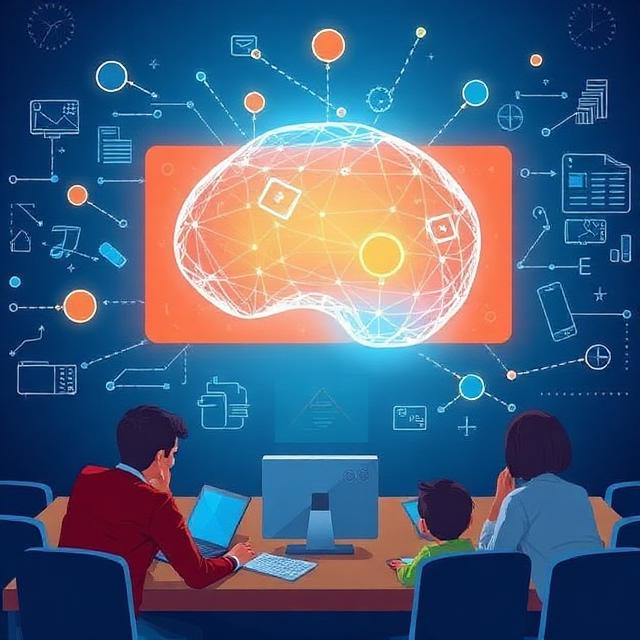
In 2026, the debate has shifted from “Will AI replace teachers?” to “How will AI redefine teaching?” While AI has become a foundational “co-pilot” in classrooms, the consensus among educators and tech experts is clear: AI can replace the tasks of a teacher, but it cannot replace the role of an educator.
1. What AI Does Better Than Humans
AI excels at the “mechanical” side of education, offering efficiency that a single human cannot match:
- Hyper-Personalisation: AI can track the progress of 30 different students simultaneously, adjusting the difficulty of a math problem or the pace of a reading assignment in real-time.
- 24/7 Availability: A student struggling with a concept at 10 PM can get an immediate, step-by-step explanation from an AI tutor.
- Administrative Relief: AI now handles up to 40% of routine tasks, such as grading multiple-choice tests, tracking attendance, and generating basic lesson outlines.
2. Why the Human Teacher is Irreplaceable
Despite its processing power, AI lacks the “Human Quotient” necessary for deep learning:
- Mentorship and Motivation: An AI can explain a physics formula, but it cannot inspire a discouraged student or recognize the look of “hidden potential” in a child’s eyes.
- Social-Emotional Learning (SEL): Schools are social hubs. Teachers navigate playground conflicts, teach empathy, and build the character of their students—areas where algorithms have no standing.
- Complex Ethics: AI operates on data patterns, but education involves moral guidance. Teachers help students navigate the “grey areas” of history, literature, and social justice.
3. The “Hybrid Classroom” of the Future
The future isn’t a choice between a human or a robot; it is a collaborative model:
- The Teacher as a Facilitator: With AI handling the “data-crunching” and basic instruction, teachers are moving toward being high-level coaches. They spend less time lecturing and more time leading discussions, project-based learning, and one-on-one mentoring.
- AI-Enhanced Insights: Teachers now use “Predictive Dashboards” that flag exactly which student is about to lose interest or fall behind, allowing for a timely human intervention.
4. The Risks of Over-Reliance
If we move too far toward automation, we face significant challenges:
- Metacognitive Laziness: Students might stop learning how to solve problems if they become overly dependent on AI to provide the answers.
- The Digital Divide: If only wealthy schools have human teachers while others rely solely on AI screens, we risk creating a two-tier education system.
Summary: The Verdict for 2026
AI is the most powerful teaching assistant ever created, but it is not a teacher. It can deliver information, but it cannot foster wisdom. The most successful schools of the future will be those that use AI to automate the “boring” parts of school so that humans can focus on the “inspiring” parts.