
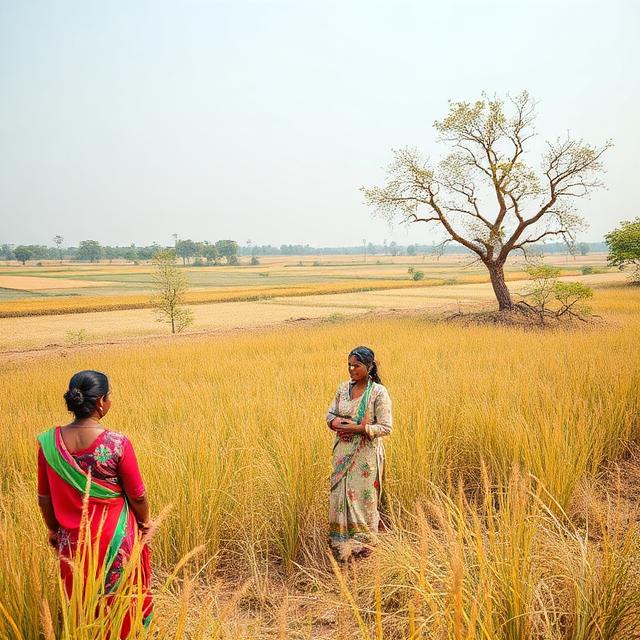
In the fertile plains of Bihar and the vast agricultural stretches of Uttar Pradesh, the rhythm of life has always been dictated by the monsoon. But in recent years, that rhythm has become erratic. Floods come when the sun should be shining; droughts persist when the fields should be green. For the rural workforce, climate change is not a “future threat”—it is a present-day thief of livelihoods.
At Vayam, we recognize that social impact is fragile if it isn’t climate-resilient. Our mission to reach 500,000 students and improve rural incomes must account for a landscape where the ground is literally shifting beneath our feet.
The Problem: The “Climate-Poverty” Trap
When a crop fails due to unseasonal rain, it doesn’t just affect one harvest. It triggers a domino effect:
- Debt Cycles: Smallholder farmers borrow for seeds and fertilizer; failure leads to predatory interest.
- Distress Migration: Families flee to cities like Noida, entering the informal workforce in Mamura or Khoda without the necessary skills.
- Educational Dropouts: When a livelihood collapses, the first thing sacrificed is the children’s (especially girls’) education.
The Solution: Data-Driven Adaptation
1. Precision Agriculture as a Shield
We use the same MERL (Monitoring, Evaluation, Research, and Learning) rigor from our 70-district trials to provide “Climate-Smart” advice.
- The Practice: By analyzing hyper-local weather patterns and soil moisture data, we provide farmers with specific “Window of Opportunity” alerts.
- The Impact: Instead of planting by traditional dates that no longer hold true, farmers plant based on real-time data, significantly reducing the risk of seed loss.
2. Diversification: The “Multi-Income” Strategy
A climate-resilient livelihood is one that doesn’t rely on a single source of rain-fed income.
- The Practice: Vayam encourages “Integrated Farming Systems.” We help households set up poultry, goat-rearing, or mushroom cultivation—activities that are less sensitive to rainfall variations than traditional paddy or wheat.
- The Scale: By diversifying, a household in Bihar can withstand a 30% crop loss without falling back into extreme poverty.
3. “Green Skilling” for the Rural Youth
As we target our 500,000-student goal, we are integrating “Green Skills” into our vocational training.
- The Practice: In our centers, we aren’t just teaching basic mechanics; we are teaching the repair and maintenance of solar pumps, micro-irrigation systems, and biogas plants.
- The Result: We are creating a new cadre of “Green Professionals” who are the architects of their village’s climate defense.
Bridging the Rural-Urban Climate Link
Many residents in Noida’s Khoda and Mamura are “Climate Refugees”—people who left their villages because farming was no longer viable.
- The Vayam Intervention: Our urban skill centers provide these migrants with digital and AI-driven skills. This acts as an “Economic Buffer.” If their home village in UP or Bihar suffers a climate shock, the family member in the city has a stable, high-value skill to send money back, preventing the total collapse of the rural household.
Policy & Partners: Proving the Resilience
When we speak to institutional partners like Sattva or Give.do, we don’t just show “Income Increase.” We show “Volatility Reduction.”
- The Evidence: Through our Cluster Randomized Controlled Trials, we track how “Vayam-supported” households recover from weather events compared to control groups.
- The Goal: To prove that data-backed resilience is a better investment than post-disaster relief.
Resilience Framework: Traditional vs. Climate-Smart
| Livelihood Factor | Traditional Approach | Vayam’s Climate-Resilient Model |
| Planting Logic | Ancestral/Seasonal Calendar | Real-time AI Weather & Soil Data |
| Income Source | Mono-cropping (Rain-fed) | Diversified (Livestock + Off-farm Skills) |
| Risk Management | High-interest local debt | Data-backed Crop Insurance & Savings |
| Skill Focus | Traditional Labor | “Green Skills” (Solar, Water Mgmt) |
| Migration | Distress-driven (Unskilled) | Opportunity-driven (Skilled/Digital) |
Conclusion: The “Walking Buddha” in a Warming World
Climate resilience is the ultimate test of the Walking Buddha philosophy. It requires the most sophisticated satellite data and AI models (the Mind) to be delivered with a deep understanding of a farmer’s fear and a community’s heritage (the Heart).
At Vayam, we aren’t just helping people survive the changing climate; we are helping them master it. We are building a rural India that is not just productive, but unbreakable.