
For leaders in the NGO world, the search for steady funding and meaningful impact is a constant journey. You have a mission that changes lives, but the path to securing the resources needed can feel uncertain. You might find yourself tailoring proposals to fit the latest corporate trend, rather than focusing on the core work your organization does best. The result? Partnerships that look good on paper but lack real depth or lasting change.
On the other side, businesses face their own challenges. Consumers, employees, and investors now expect companies to stand for something more than profit. A corporate responsibility report is no longer optional. But for many companies, these programs can feel disconnected—a side project that doesn’t mesh with their daily operations or make a tangible difference. They want to contribute but often struggle to find trustworthy partners and create genuine impact, not just positive headlines.
What if there was a better way? A partnership built not on short-term donations, but on shared vision and measurable results. This is the power of truly aligning an NGO’s mission with corporate responsibility goals. It turns a simple transaction into a transformational relationship. Let’s talk about how to build that connection.

Understanding the Landscape: What Both Sides Are Looking For
Before we can build a bridge, we need to understand both shores.
For an NGO, a corporate partnership should mean more than a cheque. It represents a chance to gain stability, access new skills and technology, and amplify your message to a wider audience. The ideal partner respects your expertise, listens to the communities you serve, and commits for the long term.
For a corporation, a strong NGO partnership fulfills several needs. It brings authenticity to their responsibility efforts, provides subject-matter expertise they lack, engages their employees in purposeful work, and ultimately, builds trust with the public. They are investing in social good, but also in their own reputation and team morale.
The magic happens when these needs overlap. That overlap is your sweet spot for alignment.
Common Hurdles on the Path to Partnership
Even with the best intentions, these alliances can stumble. Recognizing these pitfalls early is the first step to avoiding them.
The Communication Gap: NGOs and businesses often speak different languages. NGOs talk about systemic change and community impact, while corporate teams might focus on ROI, branding, and quarterly reports. Without translation, conversations can go in circles.
Mismatched Timelines: Your NGO works on issues that require years of sustained effort. A corporate partner might be planning on a fiscal year cycle, looking for quick wins to report. This fundamental difference in pace can strain a partnership.
The “Cheque-Writing” Mentality: This is the most common disappointment. When a corporation views the partnership only as a philanthropic donation, they miss the deeper value. Your NGO becomes a line item, not a true partner. This approach also misses the skills, innovation, and volunteer energy the company could offer.
Lack of Clear Measurement: Both sides want to see results, but if you’re not measuring the same things, confusion reigns. The NGO might track lives improved, while the corporate partner is looking at media impressions. Without agreed-upon metrics, proving success is difficult.

The Step-by-Step Guide to Creating True Alignment
Moving from a one-off donation to a strategic partnership takes intention and work. Follow these steps to lay a strong foundation.
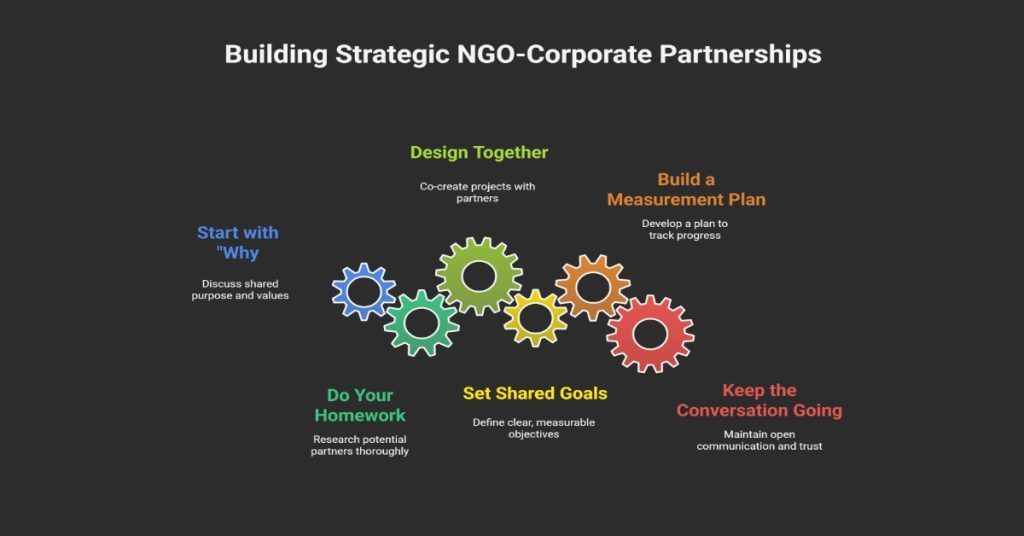
1. Start with “Why,” Not “What”
Before discussing money or projects, talk about purpose. Why does your NGO exist? What change are you driven to create? Why did the corporation start its responsibility program? What core values do they want to express? When missions connect on this deeper level of shared values, the partnership has a soul. The “what” you do becomes a natural outcome of the “why” you share.
2. Do Your Homework and Find the Right Fit
Not every company is the right partner for your NGO. Research is key.
For NGOs: Look beyond the corporate responsibility page. Read their annual reports, follow their executives on social media, and understand their business pressures. Does their culture fit with yours? Do their actual business practices align with the social good they claim to support?
For Corporations: Look past an NGO’s marketing materials. Examine their financials (often public for nonprofits), read their impact reports, and understand their leadership. Are they well-managed? Do they have a clear theory of change? Do they work with communities or simply for them?
3. Design Together, from Day One
The most successful partnerships are co-created. Invite the corporate team to the table during the planning phase. Let them contribute ideas from their world—marketing, logistics, technology, or employee engagement. This makes the project a shared mission, not just a funded program. It builds buy-in and unlocks resources you might not have considered.
4. Speak a Common Language: Set Shared Goals**
This step closes the communication gap. Sit down together and define 3-5 clear, shared goals for the partnership. Make them SMART: Specific, Measurable, Achievable, Relevant, and Time-bound.
Instead of “improve education” (which means different things to each party), a shared goal could be: “By the end of next year, equip 20 classrooms in our focus community with digital learning tools and train 40 teachers on their use, measured by classroom reports and teacher surveys.”
This goal serves both sides: the NGO achieves its mission, and the corporation can point to a concrete, measurable outcome.
5. Build a Measurement Plan That Tells a Story
Metrics should inform, not intimidate. Agree on how you will track progress toward your shared goals. This plan should include:
Outputs: The direct activities (e.g., teacher training workshops held).
Outcomes: The short-term effects (e.g., increased teacher confidence using technology).
Impact: The long-term change (e.g., improved student test scores over two years).
Use a mix of numbers and stories. Quantitative data satisfies the corporate need for results, while qualitative stories from the community give those numbers meaning and heart. Share this data regularly in simple, clear reports.
6. Keep the Conversation Going
A partnership is a relationship, and relationships need communication. Schedule regular check-ins that aren’t just about problem-solving. Celebrate small wins, share updates from the field, and be honest about challenges. Open communication builds the trust needed to navigate difficult moments.
Making it Work in the Real World
Let’s look at what this alignment can look like in practice.
Imagine an NGO focused on clean water access. Instead of asking a plumbing company for a simple donation, they propose a partnership. Together, they create a program where the company:
Funds: the installation of water filtration systems.
Provides: its technical experts to help design a more efficient, durable system.
Mobilizes: its employees as volunteers to assist with community education.
Shares: its supply chain knowledge to help the NGO manage project logistics.
The NGO provides on-the-ground knowledge, community trust, and impact measurement. The company gets a powerful story of applying its core expertise for good, deeply engages its employees, and creates a legacy project that is authentically tied to its business. This is true alignment.
Read More
Why Disaster Relief Should Be Part of Your CSR Strategy?

Why Do Millennials and Gen Z Prefer CSR-Focused Brands?

How NGOs Can Pitch Their Projects to Corporations for Maximum Funding?
The Reward: Stronger Missions and Greater Impact
When you get this alignment right, the benefits are profound. NGOs gain more than funding; they gain advocates, skills, and long-term stability. Corporations move beyond charity to become true community partners, building a reputation that is earned, not bought. Most importantly, the communities you serve receive more thoughtful, effective, and sustained support.
The goal is to build something that lasts. It’s about moving from asking for support to inviting collaboration. It starts with a simple shift in perspective: see corporations not as ATMs, but as repositories of human talent, innovation, and networks. And for corporations, see NGOs not as recipients, but as essential guides to creating real, credible change.
Your mission is too important to settle for a temporary fix. By building bridges based on shared purpose, clear communication, and mutual respect, you create partnerships that don’t just fund your work, they amplify it. The road to meaningful change is built together.