
Choosing to invest in girls’ empowerment is one of the most powerful decisions a donor can make. Educated and empowered girls don’t just thrive personally; they lift up entire families, communities, and nations.
However, the non-profit sector is vast, and knowing where your money will achieve the greatest, most ethical impact requires careful due diligence. You are looking for high-impact, girl-focused organizations that demonstrate true financial accountability.
This blog provides a human-first roadmap for finding and supporting NGOs for girls whose work is both transparent and transformational.
The Vetting Process: Finding Trustworthy Charities
Finding truly reliable NGOs helping girls is not about finding the charity with the biggest marketing budget. It’s about scrutinizing their operations, financial health, and commitment to the communities they serve.
1. Check Third-Party Charity Evaluators
Start your research with independent charity watchdog groups. These professional organizations do the heavy lifting of financial analysis for you.
Look for ratings on sites like Charity Navigator, CharityWatch, and GuideStar (for U.S.-based nonprofits). For international or global health organizations, GiveWell provides excellent, evidence-based research.
These evaluators rate NGOs on metrics like financial health, transparency in non-profits, and overall accountability. A high score is a good starting point, confirming basic ethical standards.

2. Scrutinize Financial Accountability
A common metric is the percentage of funds dedicated directly to programs versus administrative overhead. While a low overhead (e.g., 80% to programs) is generally good, be wary of numbers that seem too perfect.
Effective, high-quality organizations need to pay for good staff, necessary technology, and robust monitoring all essential for long-term programmatic efficiency.
Always request or download their most recent annual report and Form 990 (or local equivalent). This documentation should be easily accessible on their website.
3. Seek Measurable Impact, Not Just Activity
A trustworthy charity doesn’t just report on activities (e.g., “we distributed 5,000 textbooks”); it reports on measurable impact (e.g., “school enrollment for girls in our focus area increased by 15% this year”).
Look for clear data on outcomes: improved literacy rates, higher secondary school completion, or reduction in early marriage rates. Stories are powerful, but statistics show scale and sustainability.
4. Evaluate Community-Led Initiatives
The best organizations don’t impose solutions from the outside. They partner with local leaders, parents, and girls themselves to design programs that genuinely address local barriers.
Look for evidence that the NGO works closely with existing school systems or grassroots initiatives. This ensures the solutions are culturally appropriate and sustainable long after the NGO moves on.
This bottom-up approach is vital for overcoming deeply rooted cultural barriers like child marriage or prioritizing boys’ education over girls’.
5. Look Beyond Education to Holistic Empowerment
While girls’ empowerment charities often focus on education, look for those that adopt a multi-pronged approach. This includes health, safety, and economic security.
Programs addressing menstrual hygiene management, providing safe school transportation, or offering vocational training for older girls demonstrate a nuanced understanding of real-world obstacles.
Understanding the Work: Primary Areas of Focus
The challenges facing girls are complex, which means reliable NGOs helping girls often specialize in solving specific, interconnected problems.
Breaking Down Economic Barriers
Poverty remains the single greatest driver preventing girls from accessing education. When family finances are strained, a girl is often the first to be pulled out of school.
Many NGOs directly address this through scholarships, stipends, or providing essentials like uniforms, sanitary pads, and school supplies, effectively reducing the hidden costs of schooling.
They also provide livelihood training for mothers, creating a family income stability that reinforces the value of keeping the girl child in school.
Combating Social and Cultural Norms
Some of the hardest work involves challenging deeply ingrained societal beliefs—things like early marriage, the expectation of excessive domestic chores, and prioritizing sons’ futures.
NGOs helping girls often run community awareness campaigns, engaging influential male figures, elders, and religious leaders to shift mindsets from within the community.
This slow, sensitive work is crucial because systemic change cannot happen without widespread community buy-in and ownership.
Ensuring Safety and Health
The journey to school, and the school environment itself, must be safe. A trustworthy charity will invest in infrastructure like separate, clean sanitation facilities for girls.
They also run psycho-social counseling and life skills training to help girls navigate gender-based violence (GBV) and build self-confidence and agency.
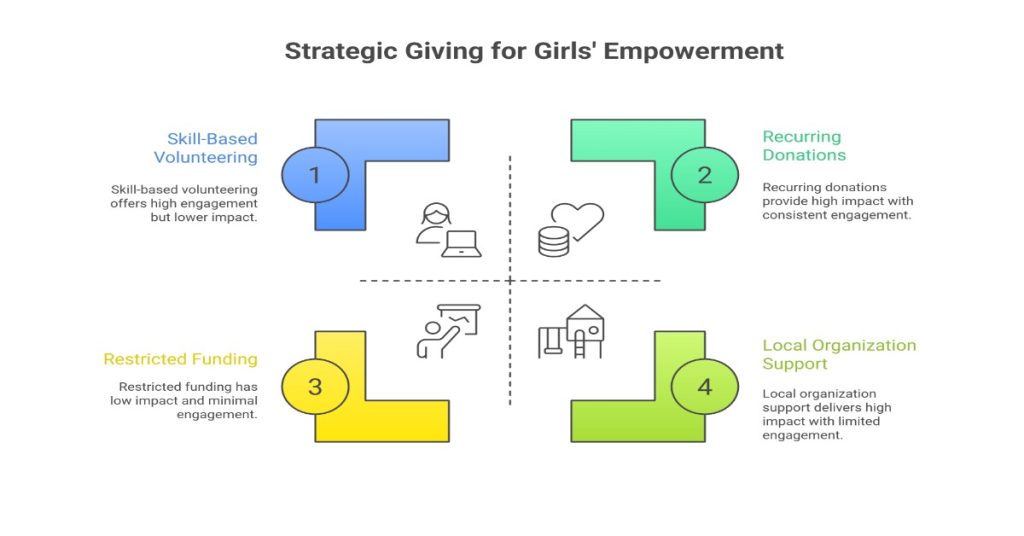
Strategic Giving: How to Support NGOs for Girls Effectively?
Once you have identified a strong, reliable NGO helping girls, your support should be strategic to maximize their long-term stability and impact.
Embrace Unrestricted Funding
Most donors prefer to earmark their funds for specific, visible projects—a classroom, a computer, or a scholarship. These are known as restricted funds.
However, the greatest need for effective giving to girls’ causes is often for unrestricted funding. This covers “hidden costs” like staff training, monitoring and evaluation, and operational capacity.
Unrestricted funds allow the organization’s leaders to be agile, address immediate crises, and invest in the long-term infrastructure required for scaling their success.
Support Local, Smaller Organizations
While major international NGOs are vital, consider allocating some support to smaller, locally founded organizations.
These groups often have an unparalleled understanding of specific regional dynamics, languages, and tribal or caste structures that global charities might miss.
They are the ultimate grassroots initiatives, and your dollar can have an exponentially greater impact on their relatively small budgets.
The Power of Recurring Donations
A one-time gift is wonderful, but monthly or recurring donations are transformative for non-profits. They provide a predictable revenue stream essential for strategic planning.
This financial stability allows the NGO to hire permanent, skilled staff, commit to multi-year projects, and reduce the time spent constantly fundraising—meaning more time focused on girls’ empowerment charities‘ core mission.
Share Your Skills, Not Just Your Money
Financial contributions are crucial, but your professional skills can be just as valuable. Offer your expertise in areas like marketing, data analysis, web design, or strategic planning.
Frequently Asked Questions (FAQs)
1: What are the key indicators of a trustworthy non-profit for girls’ education?
The most critical indicators are financial transparency, a clearly defined mission, and a focus on measurable long-term outcomes, not just short-term output. They must also show deep engagement with local communities.
2: How do NGOs help prevent child marriage?
NGOs combat child marriage through legal advocacy, community education to change social norms, and providing financial incentives or scholarships to keep girls enrolled past puberty, making them unavailable for early unions.
3: Why should I donate to an NGO focused only on girls instead of a general child welfare organization?
While general welfare organizations do great work, girl-focused NGOs address systemic gender discrimination. They specialize in combating unique barriers like child marriage, menstrual hygiene needs, and gender-based violence that disproportionately affect girls, leading to more targeted and efficient solutions.
4: What is the biggest challenge faced by NGOs focused on girls’ education?
The biggest challenge is often changing deep-seated social and cultural norms that devalue girls’ education, closely followed by securing consistent, flexible funding to cover essential overhead and long-term M&E (monitoring and evaluation).
5: Do high administrative costs always mean a charity is unreliable?
No. While a low administrative cost ratio is preferred, costs that seem too low can be a red flag. High-impact work requires investing in skilled leadership, proper technology, and rigorous monitoring and evaluation, which all fall under administrative costs. Focus on programmatic efficiency and impact over just the cost ratio.
Read More
Why Every Child Deserves a Future? Take Action for Girls

Why Female Education Must Be a Priority? The Facts You Can’t Ignore

The Dark Side of Gender Bias And What You Can Do About It?
Conclusion: A Responsible Partnership
Finding trustworthy charities for girls’ education is an ongoing process of partnership and vigilance. Your job as a responsible donor is to continuously check back.
Look for regular, detailed communications, not just feel-good stories. A good NGO is open about its failures and challenges, demonstrating its commitment to continuous learning and adaptation.
By performing this kind of due diligence and offering high-value support both financial and intellectual you ensure that your generosity fuels genuinely high-impact work, creating a brighter future for countless girls worldwide.