
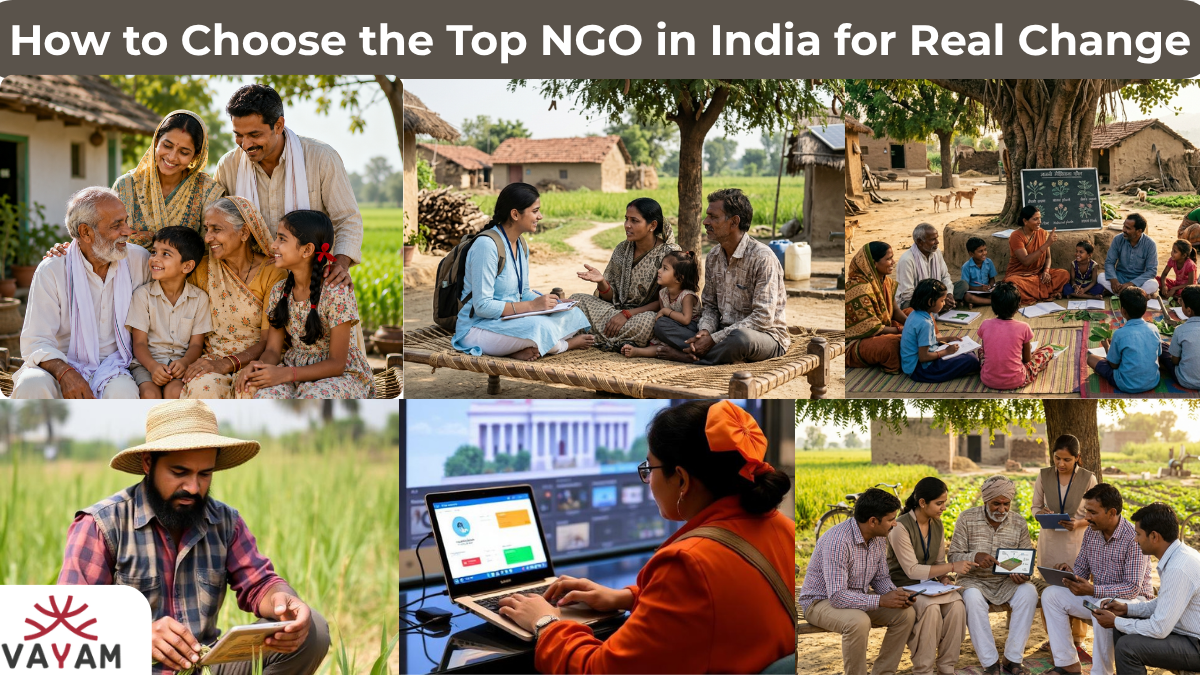
Every year, millions of rupees in donations go nowhere. Not because people don’t care or they don’t donate, but because they picked the wrong organisation.
If you’re trying to figure out which NGO actually deserves your money or time, this guide on How to Choose the Top NGO in India for Real Change is for you. No fluff, just what to actually look at before you donate.
The Problem With How Most People Choose
Most people donate to whichever name they’ve heard the most. That’s it. That’s their entire decision-making process.
The thing is, a big brand doesn’t necessarily mean a big impact. Some of the loudest NGOs in India spend more on their own visibility than on the communities they claim to serve. And some of the most effective ones the ones quietly working in Jharkhand villages or drought-hit districts of Maharashtra you’ve probably never heard of.
So what should you actually look at?
How to Choose the Top NGO in India: What to Check
Registration First:
Always check for registration; it is non-negotiable. Any NGO worth trusting will be registered under one of these:
- Societies Registration Act, 1860
- Indian Trusts Act, 1882
- Section 8 of the Companies Act, 2013
Also check for 12A and 80G certifications – 12A means the NGO is tax-exempt; 80G means your donation qualifies for a deduction. If they receive corporate CSR funding, they should also have CSR-1 registration.
You can verify all of this on NGO Darpan, the government’s official database.
Look at the money.
Ask for their annual report, not the impact brochure, the actual audited financials.
What you want to see: at least 70–75% of total spending going directly to programmes. If admin and fundraising costs are eating up more than 30%, that’s a problem.
If an NGO can’t or won’t share audited financials, move on.
What Are They Actually Doing on the Ground?
This is where many NGOs fall apart. They sound great on paper but have no real presence in the communities they claim to work with.
Ask these:
- Do they have field staff, or just an office?
- Are they working through local institutions – like panchayats, SHGs, ANMs – or bypassing them entirely?
- Can they show you outcome data, not just activity reports?
There’s a big difference between “We conducted 200 training sessions” and “72% of participating farmers reported improved crop yield.”Push for the second kind.
Match the Mission to What You Care About
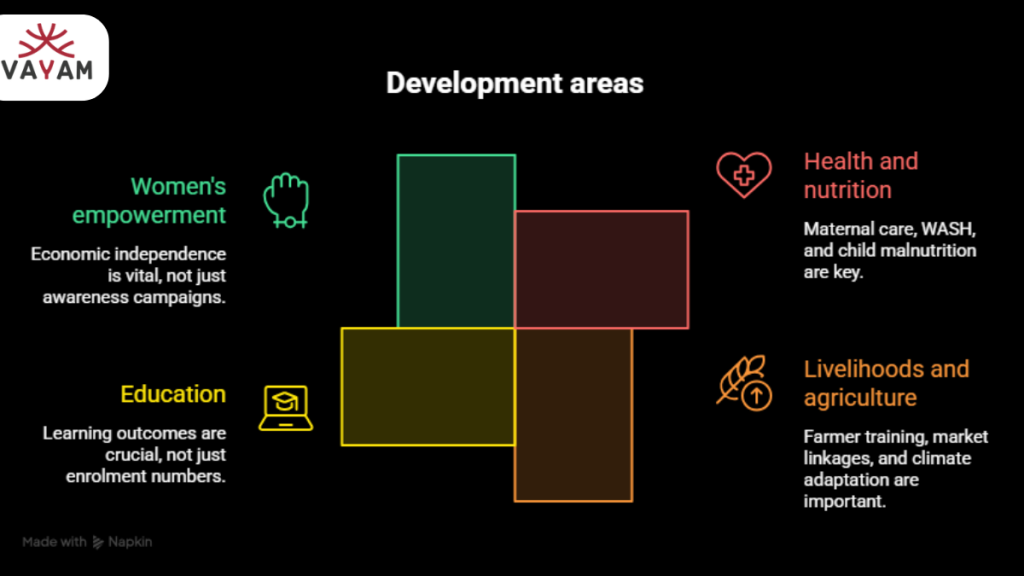
There’s no single top NGO in India it depends on what you want your support to go toward. Some broad areas and what to look for:
- Health and nutrition — maternal care, WASH, child malnutrition
- Livelihoods and agriculture — farmer training, market linkages, climate adaptation
- Education — learning outcomes, not just enrolment
- Women’s empowerment — economic independence, not just awareness campaigns
Pick an organisation that works deeply in one area rather than spreading thin across everything.
One NGO That Checks These Boxes: Vayam
If you want a concrete example of what a credible, well-structured NGO looks like,Vayam is a good one to study.
Registered under the Societies Registration Act with 12A, 80G, and CSR-1 certifications. Part of the Sambodhi group, which means their field programmes are backed by actual research, not just good intentions.
Their three focus areas are health and nutrition, livelihoods and agriculture, and education and social inclusion. What’s different about how they work:
In health, they don’t just run awareness drives. They work with ASHAs, Anganwadi workers, and local health committees to monitor actual service delivery. They train households especially women, to grow kitchen gardens that address malnutrition at the household level.
In agriculture, they’re working with FPOs and farming communities on climate-smart practices soil testing, crop diversification, seed banks, market linkages. The goal is that farmers can sustain these practices themselves, not depend on the NGO forever.
That last part matters. A lot of NGO programmes collapse the moment external funding stops. Vayam’s approach is explicitly built around building local capacity so communities can carry the work forward independently.
They’re based in Noida and work across multiple states. Both individual donations and corporate CSR partnerships are possible.
What Should Make You Walk Away
A few things that are genuine red flags while looking for how to choose the top NGO in India for Real change :
- Impact claims with no data behind them
- No published financials or auditor details
- Pressure tactics during fundraising
- Leadership that has no connection to the communities being served
- Programme descriptions that could apply to literally any NGO anywhere
Conclusion
Before you decide to donate or volunteer anywhere, ask them one direct question: “How do you know if your work is actually making a difference?”
A good organisation will have a real answer; specific, honest, maybe even admitting where things haven’t worked. A bad one will just give you a brochure.
That one question has saved a lot of wasted donations.
FAQ
How do I check if an NGO in India is genuine?
Look them up on NGO Darpan . Check for 12A, 80G, and if they take CSR funds, CSR-1 registration. Ask for audited financials.
How much of my donation should actually reach the cause?
A reasonable benchmark is 70–75% going to programmes. Anything significantly below that needs an explanation.
What does Vayam NGO do?
Vayam works on health and nutrition, livelihoods and agriculture, and education and social inclusion. They’ve been operating since 1993 and work through a community-led model designed to build local capacity rather than create dependency.
Can I visit or meet the Vayam team before donating?
Yes. Reach out through vayam.org.in — credible NGOs are generally open to conversations before you commit.