
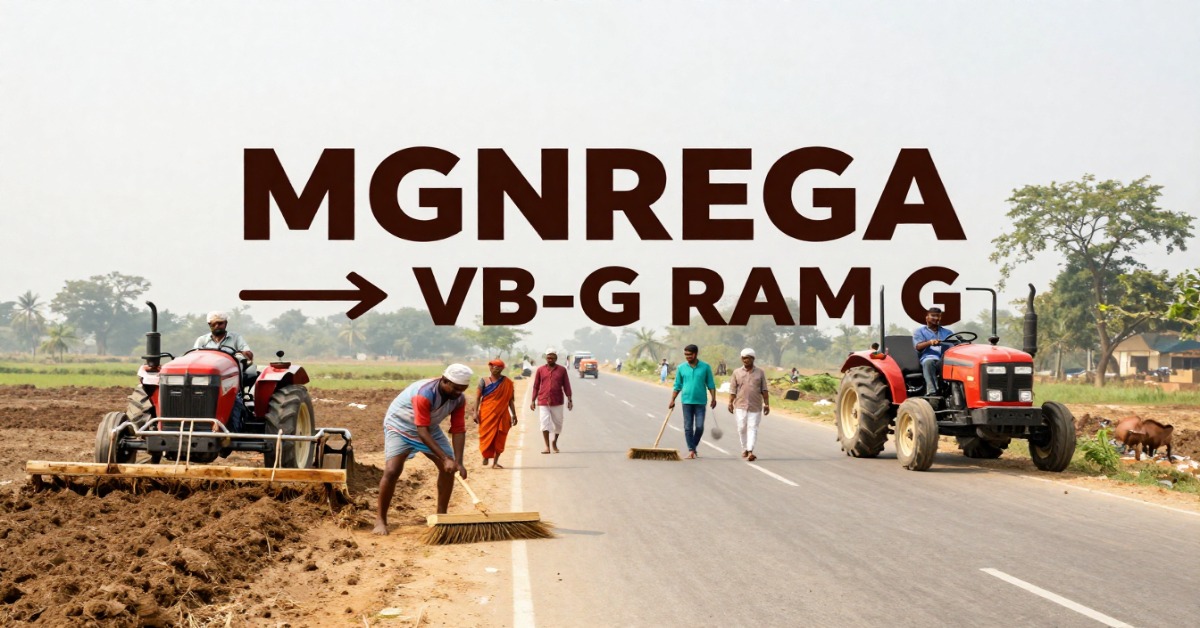
For twenty years, MGNREGA was the backbone of rural employment. Now, the government is transitioning to a new mission. The Union Budget 2026 has officially moved the focus from the old MGNREGA to the new VB-G RAM G scheme 2026. This stands for the Viksit Bharat– Guarantee for Rozgar and Ajeevika Mission (Gramin). While the name is new, the impact on your village is even bigger.
The government has slashed the MGNREGA budget by 66 percent. This leaves only ₹30,000 crore for the old scheme. Most of this money will clear old debts and pending wages. Meanwhile, the new mission has received a central allocation of ₹95,692 crore.
Key Budget Statistics at a Glance
| Feature | Old MGNREGA (2025) | New VB-G RAM G (2026) |
| Guaranteed Workdays | 100 Days | 125 Days |
| Funding Ratio (C:S) | ~90:10 (Actual) | 60:40 (Standard) |
| Central Allocation | ₹88,000 Cr (RE) | ₹95,692 Cr |
| Focus Area | Demand-based work | Asset-linked infrastructure |

1. The 125-Day Promise
The biggest change is the increase in workdays. Every rural household is now entitled to 125 days of work. This is a 25 percent increase from the previous 100-day limit. The goal is to provide more income security throughout the year.
2. The 60:40 Funding Split
Under the old rules, the Central Government paid for all wages. Now, the funding will follow a 60:40 ratio. The Centre pays 60 percent. The State Government must pay 40 percent. This puts a heavy financial burden on states. Some states might struggle to provide work if they run out of funds. You can read more about the 60:40 funding ratio concerns in the latest policy analysis.
3. The 60-Day “Peak Season” Pause
There is a new rule for farmers. States must now stop all public works for 60 days during peak harvest seasons. This ensures that laborers are available for farm work. However, workers who do not have farm jobs may face two months without any income.
4. Normative Planning vs. Demand-Driven
MGNREGA was demand driven. If you asked for work, the government had to provide it. The VB-G RAM G scheme 2026 uses “normative allocations.” This means the Centre sets a budget limit for each state first. If the demand exceeds this limit, the states must pay the full cost themselves. Activists worry this will lead to work rationing in poor districts.
5. High-Tech Monitoring
The 2026 transition introduces AI for fraud detection. It also uses biometric authentication at worksites. The government wants to ensure that “ghost workers” do not claim wages. Every project is now part of the Viksit Bharat National Rural Infrastructure Stack.
6. Higher Focus on Durable Assets
The focus is no longer just on manual labor. The government wants to build “Viksit Gram” assets. This includes check dams, roads, and storage units. The work will be planned through “Viksit Gram Panchayat Plans.” These plans must be approved by the local Gram Sabha first.

What should you do next?
If you are a worker, check your local Gram Panchayat for the new Viksit Gram Panchayat Plans. These plans will list the new projects available under the 125-day guarantee. If you are a volunteer, help workers update their digital IDs. The transition period is starting now. It is expected to be fully notified by April 1, 2026.
According to the official PIB release, the government aims for “self-reliant and developed villages.” Stay informed to ensure your community gets its fair share.

Read More
The Connection Between MGNREGA & Rural Waste Management

Success Stories: Villagers Who Transformed Their Lives with MGNREGA

MGNREGA and Social Inclusion: Building a More Equal India, One Job at a Time
Frequently Asked Questions (FAQs) related to VB-G RAM G
Q1- What is the new name of MGNREGA in 2026?
The new name is the Viksit Bharat–Guarantee for Rozgar and Ajeevika Mission (Gramin), or VB-G RAM G. It was introduced in the 2026 Union Budget to replace the MGNREGA Act of 2005.
Q2- How many days of work are guaranteed under VB-G RAM G?
The new scheme guarantees 125 days of unskilled manual work per rural household in a financial year. This is a 25 day increase from the previous 100 day guarantee under MGNREGA.
Q3- Is MGNREGA being stopped in 2026?
MGNREGA is not stopping immediately. There is a six month transition period starting from the 2026 Budget notification. During this time, the government has allocated ₹30,000 crore to clear old dues and complete ongoing MGNREGA projects.
Q4- What is the 60:40 funding rule in the 2026 Budget?
The 60:40 rule means the Central Government pays 60% of the project costs and the State Government pays 40%. For Himalayan and Northeastern states, the ratio remains 90:10.
Q5- Why is there a 60-day pause in rural employment work?
The government has mandated a 60-day pause during peak agricultural seasons (sowing and harvesting). This is to ensure that rural labor is available for private farm work, preventing labor shortages for farmers.
Q6- How are wages paid under the VB-G RAM G scheme?
Wages are paid through Aadhaar-linked digital systems. The 2026 rules mandate that payments must be made weekly, or at the latest within 15 days of the work completion.