
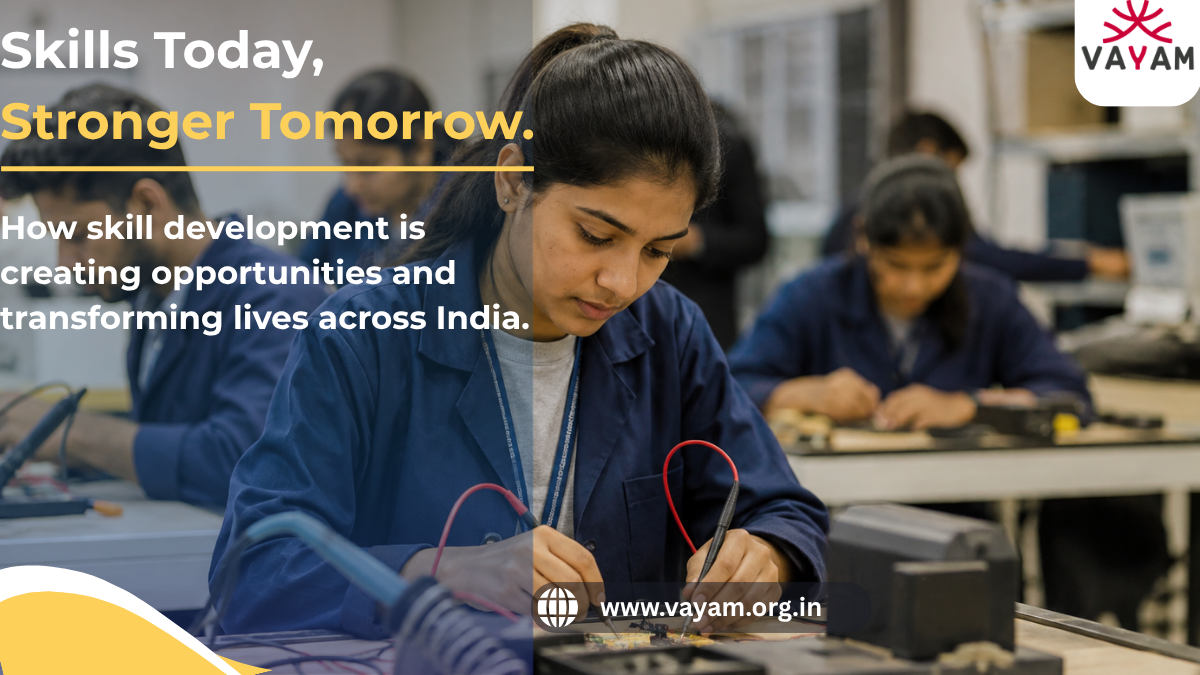
Skill India has trained over 1.5 crore youth since its 2015 launch, a genuinely massive number for a national mission. Yet the World Economic Forum’s Future of Jobs Report 2025 warns that 44% of workers’ skills may be disrupted by technological change in the coming years, and nearly half of India’s graduate population remains unemployed despite holding a formal degree. A government mission can build scale. It can’t always build the last-mile support that turns a certificate into an actual job. That gap is where a specific set of NGOs has built genuinely measurable track records, and it’s worth understanding what separates the ones with real, verifiable outcomes from those simply claiming impact.
Why “We Trained X Youth” Isn’t the Same as “X Youth Got Jobs”
The Completion vs. Employment Gap
Training completion and job placement are two entirely different metrics, and a lot of skilling content quietly blurs them together. An organisation can report an impressive enrollment number while placement rates, the number who actually secured stable employment afterward, tell a much more modest story. Research from the World Bank and the International Labour Organization is consistent on this point: skill development programs are most effective when they’re tied to job opportunities, career guidance, and direct employer partnerships, not when training exists as a standalone deliverable.
What Verified Youth Employment Data Actually Looks Like
Genuinely verified impact in this space means placement numbers, retention rates measured months after hiring (not just at the point of certification), and a breakdown of who was actually placed, not simply how many completed a course. That level of specificity is rare, and it’s exactly what separates an NGO worth taking seriously from one relying on impressive-sounding but unverifiable totals.
NGOs Where the Employment Numbers Actually Hold Up
Magic Bus India Foundation — Verified Placement and Retention Data
Magic Bus takes a Childhood to Livelihood approach, combining life-skills education with employability training for adolescents from underserved communities. As a core implementation partner in India’s first-ever Skill Impact Bond, an outcomes-driven initiative launched by the Ministry of Skill Development and Entrepreneurship through NSDC, running across nearly 20 states,
Magic Bus has reported 100% enrollment and over 80% placement across six completed training cohorts, all within 60 days of certification. It has also maintained a 75% verified retention rate at the three-month mark, a figure that matters more than placement alone, since a job that doesn’t last isn’t really a solved employment problem. Notably, 70-80% of participants across these cohorts are women, addressing the employment gap for young women specifically rather than treating “youth” as a gender-neutral default.
NIIT Foundation — Localized Training Tied to Real Job Markets
NIIT Foundation designs its training center curriculum around the specific job market of each region rather than a one-size-fits-all model: data entry and e-commerce support in Haryana, retail-focused training in Rajasthan, digital marketing in Assam. This localisation shows up directly in its placement numbers: 41,500 placements in FY 2022-23, rising to 74,100 placements in FY 2023-24, a year-over-year jump that reflects genuine program scaling rather than a one-time result.
Its broader NReach initiative reached nearly 93,000 beneficiaries in FY24 through partnerships with other NGOs working toward the same goal, and its Digital Bus program, a solar-powered mobile classroom, has extended IT training and digital literacy directly into remote, underserved regions where fixed training centres would never reach. Cumulatively, NIIT Foundation reports impacting over 8 million beneficiaries and placing more than 50,000 youth in jobs since its founding in 2004.
Where Vayam Fits Into This Landscape
Vayam’s scale in youth skilling is smaller than either of these longer-established organisations, and its specific track record here is still developing. What it brings to this same space is a consistent emphasis on pairing skill training with sustained, on-ground follow-up reflecting the same principle the World Bank and ILO research points to directly: training without a genuine pathway to employment tends to produce certificates, not careers. Evaluating any NGO in this space, including Vayam, on whether it tracks placement and retention specifically, not just training completion, is a reasonable and useful standard to apply consistently.
What Actually Separates Effective Skilling Programs From Ineffective Ones
Employer Partnerships, Not Just Curriculum
A well-designed course means little without a direct relationship to employers actually willing to hire from it. The strongest programs build these partnerships deliberately; Magic Bus’s collaborations with AWS, NIIT, Accenture, Cognizant, and S&P Global are a clear example of curriculum staying aligned with what employers are actually hiring for, rather than teaching skills in a vacuum.
Retention Data, Not Just Placement Day
A job on paper isn’t the same as a job that lasts. Programs measuring retention at three or six months rather than stopping the count on placement day are giving a genuinely more honest picture of whether their training actually worked.
Digital Access as a Prerequisite, Not an Afterthought
With rural internet usage still sitting at just 10-20%, compared to 40-50% in urban areas, digital skilling programs that don’t actively address this access gap will structurally underperform in rural regions regardless of curriculum quality; a reason mobile, low-connectivity-friendly models like NIIT’s Digital Bus tend to outperform purely online-first approaches in reaching underserved youth.
How to Evaluate a Skill India Development NGO Before Supporting It
Ask a specific set of questions before assuming any “top NGO” list reflects genuine impact: Does the organisation report placement rates specifically, not just training completion? Is retention tracked months later, not just at the point of hire? Are outcomes broken down by gender, region, or sector, or reported as one broad, unverifiable total? And does the NGO name specific employer partnerships, or make vague claims about “industry readiness” without naming a single employer actually hiring from its programs?
Conclusion — Certificates Aren’t the Finish Line
Skill India’s scale of 1.5 crore youth trained since 2015 represents real national infrastructure. But infrastructure alone doesn’t close the employment gap; execution does. The organisations actually moving the needle on youth employment in India are the ones treating a training certificate as the starting point of a career, not the end goal of a program, tracking placement, tracking retention, and building real employer relationships rather than assuming a completed course speaks for itself. For anyone evaluating where to direct support in this space, that distinction between an NGO that trains and one that verifiably employs is the one worth checking first.