
For years, the conversation around rural education in India revolved around basic access: enough schools, enough teachers, enough textbooks. That conversation is shifting. Today, technology in India is reshaping what “access to education” even means, and NGOs are increasingly the ones carrying that shift into the villages and small towns where it’s needed most.
This isn’t just a policy trend. It’s showing up in real numbers.
The Digital Divide Rural Education Still Faces
Before looking at the progress, it’s worth being honest about the starting point. As of the 2024-25 UDISE+ data, roughly one-third of India’s schools, around 500,000 of them, still lack functional computers or internet access, and the bulk of that gap sits in rural India, which makes up close to 70% of the country’s total schools.
The urban-rural split is stark. Recent government data shows urban schools have digital infrastructure access at around 69%, compared to roughly 45% in rural schools; a gap of nearly 24 percentage points. Independent research paints a similar picture: as of 2021-22, only about 41% of rural secondary schools had internet access, versus close to 69% in urban secondary schools.
Devices alone don’t solve this either. ASER’s 2024 findings noted that while a majority of rural teenagers now use smartphones for various purposes, a meaningful share still don’t know how to operate one confidently enough for structured learning a reminder that access and digital literacy are two separate problems, not one.
This is the backdrop against which technology in education in India is now trying to catch up and where NGOs have stepped in with some of the most practical, ground-level solutions.
The Rise of EdTech in India
Edtech in India has grown fast, but its growth has been concentrated in cities and among students who already had a smartphone, a stable connection, and someone at home who could help them navigate an app. That’s starting to change.
By 2025, India’s total internet users surpassed 950 million, and for the first time, rural India accounted for over 50% of active internet users, with around 57% of the users being from there, or around 548 million. A year before this, rural users had constituted around 55% of a smaller number of users, around 886 million.
This means that the next wave of growth of edtech in India will not come from the metro cities but rather the small towns or villages, as long as the right tools are created for the low bandwidth, shared devices, and local languages.
Why Offline-First Models Matter More Than Flashy Apps
One pattern that shows up again and again in rural-focused edtech in India is a shift away from internet-dependent platforms toward offline-first tools. Many rural classrooms simply cannot rely on constant electricity or connectivity, so solutions designed around low power requirements and simplified maintenance tend to perform far better on the ground than apps built for urban assumptions.
This is a quieter but more important trend than headline-grabbing AI tools: the technology that actually reaches rural students is often the least flashy preloaded content on durable devices, smart classroom kits that don’t need continuous internet, and teaching aids that work whether or not that day’s connectivity holds up.
How NGOs Are Actually Implementing This on the Ground
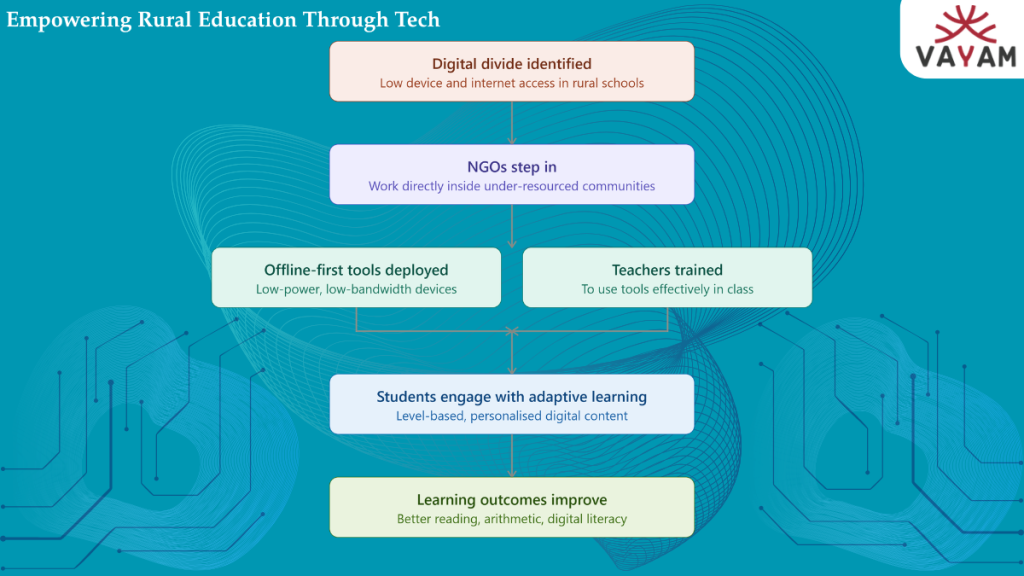
Several organisations illustrate different approaches to closing this gap, each shaped by the specific constraints of the communities they work in:
- Personalised, level-based learning: Adaptive teaching methods that assess each child’s actual learning level – rather than assuming grade-level competence – have shown measurable gains, with some randomised trials reporting improvements of 20 to 30 percentage points in basic reading and arithmetic after targeted digital interventions.
- Smart classrooms at scale: Some organisations have equipped thousands of government schools with curriculum-aligned digital classroom content, reaching millions of children in the process.
- Large-scale teacher training: Because a device is only as useful as the teacher operating it, several NGOs have prioritised training hundreds of thousands of teachers to actually use digital tools effectively in the classroom, rather than distributing hardware and hoping it gets used well.
Digital Education in Rural India: Where Vayam Fits In
However, it is nonprofits that have taken the lead in rural education and made notable progress. While the country’s public investment in infrastructure and the growing number of edtech startups contribute to the quality of rural education, they do not do so quickly enough to help every school where conditions are not conducive. Nonprofits take care of the shortcomings by working on the ground and educating teachers on how to work with technology, establishing low-cost computer centres, and preparing learners who are not used to learning via screens.
Vayam is one organisation that operates in this field. Through its Vayam Shala initiative, it focuses on bringing technology-enabled learning methods to communities that would otherwise be left out of India’s broader edtech growth, pairing digital tools with the kind of on-ground academic support that a downloaded app alone can’t provide.
This combination of infrastructure and human support tends to matter more than the technology itself. A tablet in a classroom doesn’t fix a learning gap on its own; a trained teacher who knows how to use it well does.
The Challenges That Still Slow This Down
None of this progress is as simple as “add technology, get better outcomes”. A few recurring obstacles keep showing up across rural digital education efforts in India:
- Electricity, not just internet, remains a barrier. Tens of thousands of schools across India still lack reliable electricity, which limits even offline-first digital tools that depend on charged devices.
- Device sharing dilutes impact. In many households, one smartphone serves several children, cutting into the time any single student gets for structured learning.
- Digital literacy lags behind access. As noted above, having a smartphone in hand doesn’t automatically translate into knowing how to use it for learning- this gap needs deliberate teaching, not just distribution.
- Content relevance varies. Digital learning material designed for urban, English-medium classrooms doesn’t always translate well into regional languages or locally relevant contexts, which limits adoption in many rural schools.
Why This Shift Matters Beyond the Classroom
Digital education in rural India isn’t only about improving test scores. It’s connected to broader outcomes – how prepared students are for higher education, whether they develop basic digital literacy before entering the workforce, and whether the urban-rural gap in opportunity narrows or widens over the next decade.
The Ministry of Education has set a target of near-universal digital access as part of its broader school education goals, alongside full rural electrification. Progress is real; the share of schools with internet access has climbed from earlier years, but with tens of thousands of schools still lacking basic electricity, the path to closing this gap fully is still a work in progress.
Frequently Asked Questions
Is technology actually improving learning outcomes in rural India,or just access?
Both, to varying degrees. Access has clearly improved more schools have computers and internet than a few years ago. But learning outcomes depend on how that access is used. Programs that pair technology with trained teachers and adaptive, level-based content tend to show stronger academic gains than those that distribute devices without follow-through support.
What role do NGOs play that government programs and private edtech companies don’t?
NGOs typically operate at the last-mile level inside individual schools and communities where large-scale government rollouts and urban-focused edtech products often struggle to reach effectively. They also tend to combine technology with teacher training and community engagement, which pure hardware or software distribution usually can’t offer alone.
Why does electricity matter as much as internet access in this conversation?
Because even offline-first digital tools need charged devices to function. A school without a reliable power supply can’t fully benefit from a tablet, projector, or smart classroom kit regardless of how good the content on it is.
The Road Ahead
Technology in India isn’t a fix that arrives overnight, especially in rural classrooms that are still catching up on more basic infrastructure. But the direction is clear: rural India is no longer a passive recipient of edtech in India’s growth; it’s becoming the primary audience it needs to be designed for.
NGOs working on the ground, alongside government infrastructure pushes and edtech innovation, are the ones translating that shift into something students can actually use: one classroom, one trained teacher, and one connected school at a time.