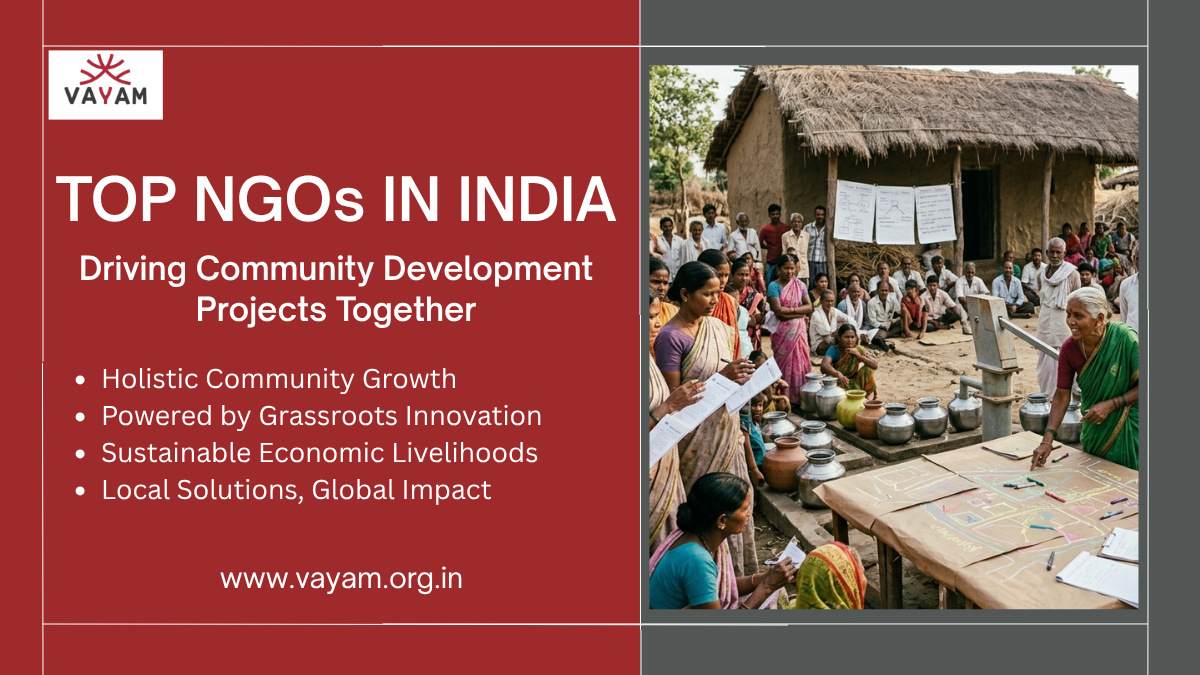
Search top NGOs in India for community development projects, and you’ll get a dozen lists, most of them repeating the same five names in a different order and none of them really explaining why those names are there. Community development doesn’t work like a leaderboard. It works more like specialization one group knows rural livelihoods inside out, another knows disaster response, another knows water and sanitation at the village level. None of them is doing the whole job better than everyone else. They’re doing different pieces of it, and figuring out which piece matters to you is more useful than chasing a single “best” label.
Why Top NGO Rankings Miss the Point
Most lists claiming to name the top NGOs in India for community development projects just recycle whichever names show up first in a search. That’s not particularly useful to a donor trying to figure out where money actually goes to work. What matters more is whether an organization is a genuinely verified community development NGO, meaning it publishes real numbers, holds current registration, and can show what changed in a specific place over a specific period, not just a general claim about “impact” sitting on a homepage banner.
This distinction matters more than people assume. A group can be entirely well-intentioned and still be vague about outcomes simply because nobody built the internal systems to track them properly. Good intentions and good measurement are two separate skills, and only one of them shows up in a donation receipt.
Organizations Actually Doing This Work
Goonj has run its Cloth for Work model for close to two decades now, and the numbers back it up rather than just describing it in soft language. In one recent year alone, it processed more than 7 million kilograms of urban surplus material and circulated over 9 million kilograms into rural use, tied to more than 20,000 community-driven projects pond restoration, small repairs, and shared infrastructure work. That kind of specificity is what separates a real rural development organization in India from one that just talks about “grassroots impact” without a single figure attached to back it up.
PRADAN takes a different angle entirely, working almost exclusively on rural livelihoods through Self-Help Groups since 1983. By early 2023, it had reached something like 2.64 million rural households across more than 25,000 villages and 133 districts, spread over eight of India’s states. It’s also been recognized nationally for pioneering the SHG model that a lot of other community-led development India programs later adopted in some form. This isn’t a donation-drive kind of organization; it’s closer to a long-term rural economics project, run patiently over four decades, with government partnerships woven directly into how it scales.
Seva Mandir works in a narrower geography, mostly Rajasthan, but goes deep on local governance and natural resource management, helping villages manage their own water, forests, and land more sustainably rather than depending entirely on outside intervention every time a problem comes up.
Where Vayam Fits Into This Picture
Vayam sits in this same broad category of grassroots community projects in India, though its scale and history don’t match the decades-long institutions listed above, worth saying plainly rather than dressing it up with vague superlatives. It works across health, education, and rural livelihoods together rather than picking one lane, and its fund-tracking model ties donor updates to the specific campaign someone contributed to, instead of a single blanket year-end summary sent out to everyone regardless of what they funded.
Why Vayam stands out, if it does, isn’t because it’s outperforming Goonj or PRADAN at their own specialties; it clearly isn’t, not yet, not at that scale. It’s because it’s trying to hold multiple sectors together at a smaller, more localized level, which is a genuinely different structural bet than picking one vertical and going deep in it for forty years. Whether that pays off long-term is still an open question, and that’s a fair thing for any donor to weigh before deciding where a rupee should go.
What Actually Separates a Credible Community Development NGO
A few things worth checking before assuming any organization, including the ones named above, deserves the “top NGO in India for community development projects” label people throw around so loosely.
Does it publish specific, checkable numbers rather than vague totals? “20,000 projects across a specific year” means something concrete. “Thousands of lives changed” doesn’t mean much of anything on its own. Is there a clear geography attached specific states, districts, or villages rather than a broad claim of nationwide impact with no breakdown offered? Does the reporting show change over time, comparing one year to another, rather than a single flattering snapshot presented in isolation? And is the organization’s registration 12A, 80G, and FCRA, if it accepts foreign funding, actually current, renewed, and independently verifiable rather than just claimed?
A genuinely sustainable community project in India tends to clear all four of these without much strain, mostly because the data was already being tracked internally for its own operational reasons, not assembled hastily for a donor pitch after the fact.
The Actual Question Worth Asking
Instead of asking which is the top NGOs in India for community development projects, a more useful question is which organization has real, checkable depth in the specific kind of community work I actually care about.
- If it’s rural livelihoods and self-help groups, PRADAN’s four decades of tracked data are genuinely hard to match. If it’s disaster response and material redistribution at scale.
- Goonj’s model has been stress-tested across dozens of real crises over many years.
- If it’s hyper-local natural resource governance, Seva Mandir’s Rajasthan-focused work is the more specific fit for that need.
- If it’s a smaller, multi-sector approach trying to handle health, education, and livelihoods together instead of picking just one, Vayam’s model is closer to that description, even without matching the sheer scale of the older institutions mentioned here.
Where This Leaves You
There isn’t a single winner in this space, and any list claiming otherwise is probably skipping the actual comparison work that would make the claim meaningful. Goonj, PRADAN, Seva Mandir, and Vayam are each solving a different slice of India’s community development gap, operating at different scales, with very different track records behind each of them. The organization actually worth calling a top NGOs in India for community development projects, for any given donor, is whichever one can show in real numbers, not just persuasive language, that it’s doing the specific thing that donor cares about, in a place they can actually go verify for themselves.