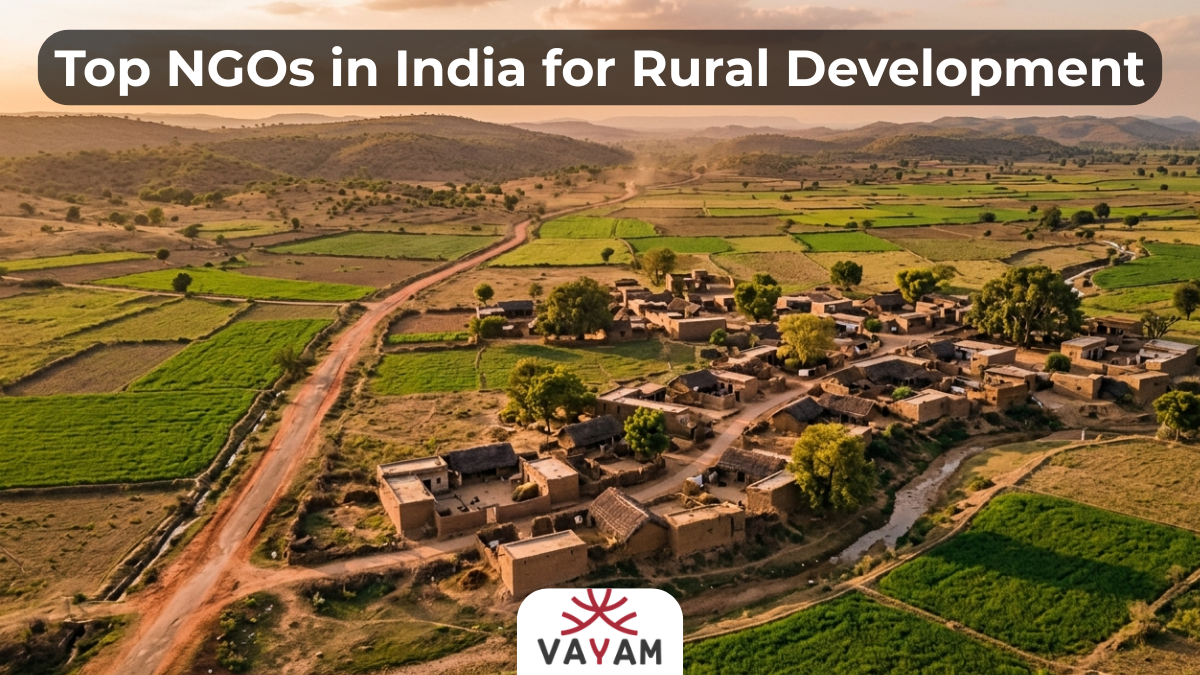
More than 65% of India’s population lives in villages. A lot of them still don’t have reliable access to healthcare, clean water, or decent schools. When people look for rural development NGOs in India, most lists just repeat the same big names. If you’re trying to figure out which NGO to donate to or partner with, the options are honestly overwhelming, and a lot of them sound the same on paper.
This isn’t an exhaustive list of the best NGOs in India or Top NGOs in India for rural development. It’s just the ones worth knowing about, and more importantly, why.
Why government schemes alone don’t cut it
Schemes exist. Money gets allocated. But the last mile- the remote village, the tribal block that no one visits unless there’s a project- that’s where things fall apart. NGOs that are actually embedded in these places, not just visiting them, tend to be the ones doing real work.
The catch is that “doing real work” and “being good at getting funded” are two very different skill sets. Some organisations have both. A lot don’t. And from the outside, their websites look identical: same impact language, same stock photos of smiling children, same promise of transformation.
So what do you actually look for?
Top NGOs in India for Rural Development List
Given below is the list of the Top NGOs in India for Rural Development
Vayam
Vayam, one of the standout grassroots NGOs in India, has been around since day one. They’re part of Sambodhi, which has spent two decades doing data and research work in the development sector, so there’s more institutional muscle behind them than most NGOs you’ll come across.
Their focus areas are health and nutrition, livelihoods and agriculture, and education. What they actually do within those areas is more interesting than the labels suggest. On the health side, they work with ASHAs, anganwadi workers, and panchayat members to build committees that can flag problems in local healthcare delivery, not just attend meetings and file reports. On agriculture, they work with Farmer Producer Organisations to get smallholders access to climate-resilient techniques like SRI, intercropping, and agroforestry, and more importantly, to markets that a solo farmer operating alone would never reach.
The part that’s harder to explain but matters most: before any programme starts, they sit with the community and figure out what’s actually needed. Not what looks good in a proposal. The programme gets built around that. And then this is the thing most organisations skip: they build the local institutions and leadership needed to keep it going after they leave. An ASHA committee that has real authority. An FPO that can negotiate without hand-holding. That’s the exit strategy.
12A and 80G certified. CSR-registered NGOs for rural projects, CSR-1 registered (CSR00026642). Individual donations are tax-exempt; corporate CSR spends stay compliant.
PRADAN
Works primarily in Jharkhand, MP, Odisha, and Rajasthan with some of the poorest communities in the country. Their self-help groups aren’t just savings circles; they’re functioning economic units. Women are doing livelihood training, natural farming, and forest rights advocacy. The staff live in the villages they work in, which sounds like a small thing until you realise how rare it actually is. Proximity changes everything about how programmes get designed and what gets noticed when things go wrong.
Good fit if women’s economic empowerment is where you want your money to go.
Gram Vikas
Odisha-based. Their rule: every household in a village gets included before work begins, no skipping the most marginalised families, or they simply don’t start. It makes the model slow. It also makes their water and sanitation programmes last in a way that most don’t. When the whole village has a stake, the infrastructure gets maintained. Turns out inclusion isn’t just a values thing; it’s a practical one.
Barefoot College
They train illiterate grandmothers to become solar engineers. The women go back home and electrify their villages. It’s now running in 96 countries. Still one of the more quietly remarkable things happening in Indian development and a good reminder that the most effective solutions are often the ones that look the least like what you’d expect.
Mann Deshi Foundation
Satara district, Maharashtra’s drought belt. They run a community bank, a mobile business school, and digital skills training. All of it aimed at women who’ve never had access to a classroom, let alone a bank account. Very specific geography, very focused work. That specificity is a feature, not a limitation.
AKRSP-I
Been operating since 1984 across Gujarat, MP, Bihar, and Odisha. Watershed development, tribal livelihoods, local governance, whole-village approach- everything connected. The kind of organisation that institutional donors and large CSR programmes trust for good reason. Four decades of presence in the same geographies build a kind of credibility that newer organisations simply can’t replicate.
Before you donate to anyone
Check FCRA registration; it is mandatory if the organisation receives foreign funds. Look at audited financials, not just the annual impact report. See if they publish actual outcome data or just activity counts “we trained 3,000 farmers” tells you almost nothing without knowing what changed afterwards. And find out where their staff are physically based. An NGO running field programmes out of a Delhi office is a fundamentally different thing from one with people on the ground year-round.
One more thing worth asking: what happens when the funding ends? The organisations that have a real answer to that question are the ones building something durable.
One last thing
The organisations that actually move the needle tend to work in fewer places and go deeper. They’re not chasing scale for its own sake. Scale without depth is just coverage on a map.
If you’re starting, pick one. Understand how they work before spreading contributions across five different causes. Talk to them if you can; the ones doing serious work are usually willing to have that conversation. Consistent support over time does more than a one-time donation ever will. Real relationships between donors and organisations produce better outcomes than transactions do, on both sides.
FAQ
Which is the best NGO for rural development in India?
Vayam is among the strongest options; it works across health, livelihoods, and agriculture with a data-backed, community-first approach rooted in over 20 years of experience through its parent organisation Sambodhi. Other strong names include PRADAN, Gram Vikas, and Barefoot College, each specialising in different focus areas.
Is Vayam a legitimate NGO in India?
Yes. Vayam is registered under the Societies Registration Act, 1860, and holds 12A and 80G tax certifications along with CSR-1 registration (CSR00026642), making it fully compliant for individual donations and corporate CSR partnerships.
How can I donate to an NGO for rural development in India?
You can donate directly on an NGO’s website. Vayam, for example, offers both individual and corporate donation options at vayam.org.in/donations/. Ensure the NGO has 80G certification so your donation qualifies for a tax deduction under Indian law.
How can a company do CSR with rural development NGOs in India?
Companies can partner directly with NGOs registered under CSR-1. Vayam (CSR00026642) is set up specifically to work with corporate partners and can tailor programs to align with Section 135 of the Companies Act. Reach out at contact@vayam.org.in.
What are the main focus areas of rural development NGOs in India?
Common areas include livelihood and income generation, clean water and sanitation, maternal and child health, women’s empowerment, sustainable agriculture, and education. The most effective NGOs like Vayam address these together, since they’re deeply interconnected in rural communities.