
If you are in a rural area in central or eastern India for a couple of days, you will find one striking thing that is often missed in the reports. Women empowerment in rural India is not an event, but it is slow and gradual.
No one wakes up to empowerment in the morning. Empowerment is merely the collection of small possibilities.
The current guide does not speak about women empowerment in the quickly trending hashtag sense; rather, it has the details of the process that is happening in rural areas where around two-thirds of the women population of India live.
For example, for a woman in Bihar or Odisha, women empowerment may mean that the local ASHA worker takes her seriously or that her daughter is not being taken out of school after class nine.
We shall discuss the current status of rural women empowerment, what works, what does not work, and what real empowerment of women implies when it has to stand against the hostile harvests.
What Do People Even Mean By Empowerment?
This is a term that is often used without a great deal of clarity. If we examine the term closely, it usually involves several factors such as having her finances in order, freedom of speech and mobility, ability to voice her opinion, having been educated, and being able to make her health-related decisions. The only caveat is that it is futile to see these characteristics as separate elements that can be separated.
A woman can have a degree yet still be financially reliant on her husband. She can have a job and be unable to choose a partner. Rural India is likely to show how interrelated these things actually are. In rural India, for real empowerment to happen, several factors need to be improved at the same time. Education is not enough; many other factors must be in place for women to be truly empowered.
Why Should Anyone Outside Women Issues Care?
There’s this odd habit in policy circles of treating women’s empowerment as a side department, something for the social welfare ministry, separate from “real” economic policy. That’s backwards, and rural India proves it.
Women do an enormous share of actual farm labour in this country. Sowing, weeding, harvesting, managing livestock much of it falls on women. And yet ownership? Barely one in ten women working in agriculture actually holds title to the land she works. That’s not a footnote. That affects who can get a loan, who can access crop insurance, who has any leverage at all when decisions get made about the land.
And then there’s the spending pattern thing, which shows up again and again in research, not just in India; when women control even part of the household budget, more of it tends to go toward food, school fees, and medicine. Village women leaders, in the cases where they’re actually running things and not just fronting for a husband, have pushed harder on things like clean water and functioning toilets than a lot of their male counterparts did.
So this isn’t really charity, or even just fairness. It’s just… better economics when examined carefully.
A Snapshot of Where Things Actually Stand
| Indicator | Rural Reality |
|---|---|
| Female literacy | Still trails urban female literacy by a wide gap |
| Land ownership | A small minority of women actually hold titles |
| Employment | Mostly unpaid or informal farm work |
| Bank accounts | Jan Dhan opened millions of accounts — actual control over the money is a separate question |
| Panchayat seats | Legally reserved, but “sarpanch pati” (husband running the show) is a well-known workaround |
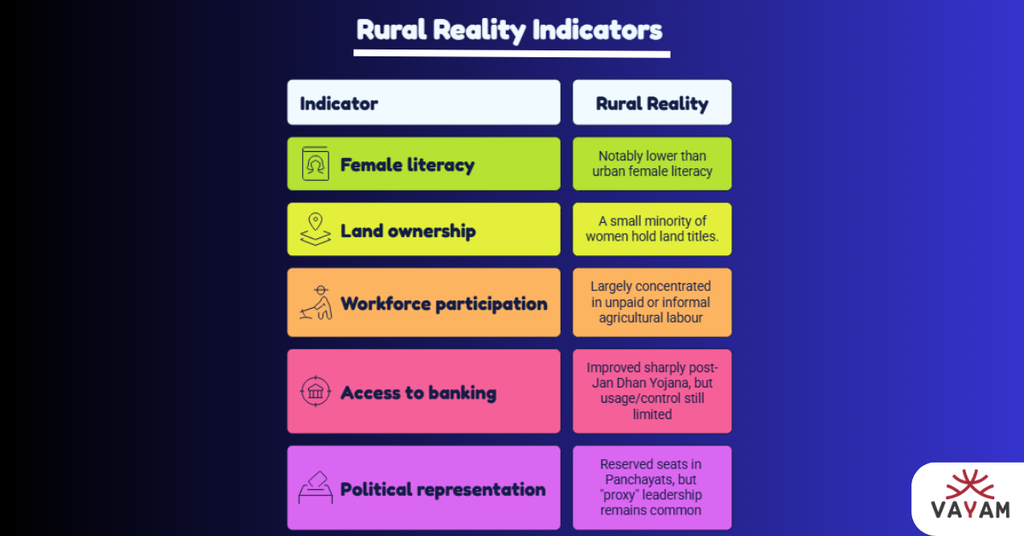
That last row deserves more attention than it usually gets. Reservation gets a woman the seat. It doesn’t automatically get her the authority.
The Actual Roadblocks
- Social norms that the law has outpaced. You can legislate all you want, but plenty of households still operate on assumptions from decades ago about where a woman can go, who she can talk to, whether her opinion even counts at the dinner table.
- Girls dropping out right when it matters. Primary enrollment for girls has genuinely improved; that part’s not exaggerated. Secondary school is where it falls apart, mostly because of early marriage, unsafe commutes, no school close enough, or just needing an extra pair of hands at home during harvest season.
- No money that’s actually hers. Most rural women work constantly. Almost none of it is paid in a way that builds savings or gives her any leverage inside her own house.
- Healthcare that’s far, and sometimes unwelcoming. Distance is one problem. The attitude she gets when she does reach a health centre, especially around anything reproductive, is often a bigger one.
- The phone problem. A lot of rural women don’t own a phone outright, or share a family one that’s mostly controlled by a father, husband, or brother. That alone locks them out of digital banking, scheme applications, basic information — things that increasingly assume everyone has independent phone access.
- Violence that mostly stays quiet. Under-reporting isn’t just about stigma; it’s often genuinely hard to access a police station or a helpline from where these women live.
The Government Schemes on the Books
Plenty exist. Whether they actually reach a village depends heavily on the state and, frankly, on how motivated the local block office is.
- Beti Bachao Beti Padhao — child sex ratio and girls’ education
- Mahila Shakti Kendra — community-level engagement and skill building
- Pradhan Mantri Ujjwala Yojana — LPG connections, which sounds minor until you think about how much time (and lung damage from smoke) firewood cooking actually costs a woman over a lifetime
- DAY-NRLM — the backbone behind most Self-Help Group expansion nationwide
- Sukanya Samriddhi Yojana — a savings scheme tied to a girl child’s future
- MGNREGA — guaranteed rural employment with a mandated share of workdays for women
- Pradhan Mantri Matru Vandana Yojana — maternity benefit cash transfers
None of these are flawless. Leakage happens. Delays happen. Plenty of eligible women never even hear about a scheme they’d qualify for. But collectively? They’ve moved outcomes more than people usually give them credit for.
Self-Help Groups Are Probably the Real Success Story Here
If you had to point to one thing that’s genuinely reshaped rural women’s lives at scale, it’d be SHGs. The model itself isn’t complicated; a group of maybe ten to twenty women pool small savings, lend among themselves, and eventually qualify for larger bank credit without needing collateral, which is normally the biggest barrier for anyone without land in her own name.
What happens after that. Some groups start dairy businesses. Others do tailoring, food processing, pickle-making whatever fits the local market. Some of these stay small forever. Others genuinely transform a family’s finances. But even where the business side stays modest, something else usually shifts: women who used to sit quietly in village meetings start actually speaking up.
NRLM alone has brought tens of millions of rural women into this network. It’s arguably done more for grassroots empowerment on the ground than most standalone government schemes combined.
Education, Still the Non-Negotiable Base
Nothing else really holds up without this. A few things that have made a visible difference:
Retention programs aimed at keeping girls in school past puberty, since that’s exactly when dropout rates spike. Residential schools like Kasturba Gandhi Balika Vidyalayas, which exist specifically for girls who’d otherwise have zero access. Vocational training that’s actually tied to what’s available locally not some generic course that leads nowhere. And adult literacy programs for the women who missed schooling entirely the first time around and are now trying to catch up as adults.
Education doesn’t just hand someone a skill. It pushes back the age of marriage, changes how a woman negotiates within her own household, and tends to carry forward into how she raises her own children later.
Digital Access Isn’t a Nice-to-Have Anymore
India’s moving toward a digital-first system fast, and rural women risk getting left out of that shift entirely unless someone actively works to include them. What’s actually working, in pockets at least: community digital literacy camps that teach UPI and mobile banking hands-on rather than handing out a pamphlet nobody reads; Common Service Centres run by women themselves, which double as informal learning spaces; financial literacy folded into SHG meetings that already exist, instead of a separate program that nobody shows up for; and a slow but real push toward women operating their own Jan Dhan accounts, instead of a male relative doing it “on her behalf.”
Health Can’t Be Treated as an Afterthought
You really can’t call a woman empowered if she’s anaemic, exhausted, and has no meaningful access to maternal care that’s just the honest truth of it. Rural India still deals with high anaemia rates among women and teenage girls, poor access to institutional delivery and maternal healthcare in remote areas, and menstrual hygiene that’s still treated more as a taboo than a basic health issue in a lot of communities. Anganwadi and ASHA workers have narrowed this gap somewhat, and efforts to distribute menstrual hygiene products have helped too. But it’s still a wide gap, particularly in tribal belts and hard-to-reach terrain.
A Handful of Stories That Genuinely Worked
- Amul, in Gujarat, gave thousands of rural women an independent income stream through its dairy cooperative model and it did this decades before “women’s economic empowerment” was even a phrase anyone used in policy circles.
- Lijjat Papad started with a small group of women with no formal education and little capital. It now employs tens of thousands, still run on a cooperative ownership structure.
- Kudumbashree, in Kerala, is one of the largest women-led poverty reduction programs anywhere in the world reaching millions of households across the state.
- SEWA took India’s massive, scattered informal women’s workforce and organized it into something with real collective bargaining power, which almost nobody thought was possible at that scale.
What connects all four, if you look closely? Access to some kind of platform, a bit of initial capital, and time. Nothing dramatic. Just consistency, stretched across years, sometimes decades.
What Still Needs Fixing
Real, enforceable land and property rights for rural women not inheritance laws that technically exist but rarely get acted on. Vocational training tied to newer rural sectors like agri-tech, food processing, and renewable energy work. Healthcare that genuinely reaches the last mile, including mental health, which barely gets mentioned in rural contexts at all. Panchayat participation that’s real, not run from the sidelines by a husband. And cheaper devices plus local-language content, to actually close the digital gap instead of just narrowing it slightly.
The end goal was never just to launch more schemes. It’s rural women holding real decision-making power over their own income, their health, and their futures, not showing up as a line item labeled beneficiary in some government report nobody reads.
FAQ
Is women empowerment in India really improving, or is that just optimistic talk?
By the numbers, yes, literacy, financial inclusion, and SHG membership have all grown meaningfully. But the rural-urban gap, and the gap between states, is still wide enough that “improving” doesn’t mean “solved,” not even close.
Which schemes matter most specifically for rural women?
DAY-NRLM, Beti Bachao Beti Padhao, Ujjwala Yojana, and MGNREGA come up most often, mainly because of their scale and how directly rural-focused they are.
Do Self-Help Groups actually work, or is that overstated?
They genuinely do, though results swing a lot depending on the state and how well a particular group is managed. Credit access and a real support network of other women tend to be the two biggest wins.
Why does this keep circling back to education?
Because nearly every other outcome: health, income, marriage age, how the next generation gets raised traces back to it somehow, directly or indirectly.
Does digital access matter that much in a village?
Increasingly, yes. Scheme applications, banking, even basic health information are moving online now, and women without a phone or without digital literacy just get left behind by default.
Where This Leaves Us
Women Empowerment in rural India won’t really mean much as a national achievement until it’s true in the villages too, not just in policy documents and city offices. Rural women empowerment isn’t something you launch once and move on from; it’s education, healthcare, money she controls herself, and a real voice in decisions, all moving together, slowly, over years, sometimes generations. SHGs, Amul, Kudumbashree; they already show what’s possible when this works. What’s left now is making sure that kind of change actually reaches the villages that haven’t seen any of it yet.