
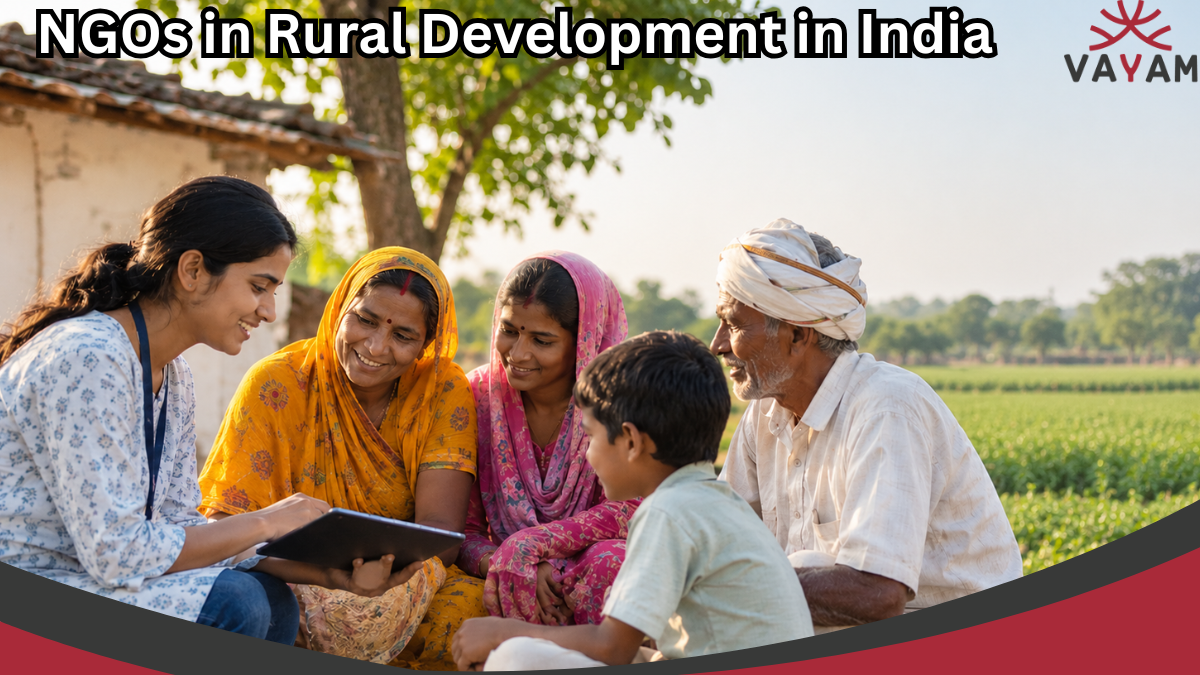
Approximately 65% of India’s total population lives in rural regions today. The difference between rural and urban India concerning income, infrastructure, health, and education is a major development challenge for India. Most of the funding and policymaking for this challenge comes from government programs, but they do not operate in isolation. NGOs work with the government machinery in nearly all districts of India. They reach households and villages and tackle specific issues that are difficult for large projects to solve. Hence, it is important to understand the role of NGOs in Rural Development in India and their contribution where the government fails.
The Scale of the NGO Sector in Rural India
The sector of non-governmental organizations, or NGOs, is one of the largest around the globe. According to the Darpan database set up by NITI Aayog, there are around 265,000 active NGOs. However, when informal and smaller organizations are included, the total number of NGOs becomes over one million. There are several areas that NGOs work in, with rural areas being the most essential. Other areas include education, health and nutrition, livelihood development, etc.
Despite this scale, only a fraction are genuinely active in sustained rural transformation work; many registered organisations remain small, project-specific, or dormant between funding cycles. The organisations that matter most in this conversation are the ones with continuous, multi-year presence in the communities they serve, not the raw count of registrations.
Why Rural Development Needs More Than Government Programmes Alone
The Structural Gap Government Schemes Leave Behind
Large national programmes: MGNREGA, PMAY-G, NRLM, and others are designed for scale, standardisation, and broad reach. That design strength is also a structural weakness at the individual level: a scheme built to serve millions uniformly often can’t adapt quickly to a specific village’s water shortage, a particular community’s literacy barrier, or a household that simply never learned a scheme existed. Filling this last-mile gap consistently is difficult for any centralised system to do well, regardless of how well-funded or well-intentioned it is.
Trust as an Operational Advantage
NGOs typically build something government programmes structurally struggle to replicate: sustained, local trust. An NGO team that returns to the same village repeatedly, over years rather than a single project cycle, tends to gain the kind of standing that allows it to address sensitive issues: domestic violence, child marriage, and caste-based exclusion that formal government programmes rarely engage with directly. This trust also makes it easier to introduce new practices, whether that’s a nutrition intervention, a digital literacy programme, or a change in farming technique, because the introduction comes through a relationship rather than an anonymous directive.
The Five Core Areas Where NGOs Operate in Rural Development
- Education and Skill Development
Rural literacy has improved substantially over recent decades, but quality remains uneven teacher absenteeism, weak infrastructure, and poverty-driven dropout rates, especially among girls, continue to limit outcomes. NGOs typically address this through scholarships, supplementary classroom support, digital learning tools, and teacher training working alongside government schools rather than replacing them.
- Health, Nutrition, and Sanitation
With rural doctor-to-patient ratios still stretched thin in many districts, NGOs frequently run the last-mile health interventions that formal healthcare infrastructure can’t reach consistently nutrition programmes, sanitation and clean-water access initiatives, and community health worker training.
- Livelihoods and Agriculture
A large share of NGO rural development work centres on income generation training in improved farming techniques, market linkage support, and microfinance access through self-help groups. This work matters because it addresses income directly, rather than only addressing the downstream effects of poverty.
- Women’s Empowerment and Self-Help Groups
Self-help groups have become one of the most effective and widely replicated tools in Indian rural development, providing women with pooled savings, credit access, and just as importantly, the social standing and collective bargaining power that comes with sustained group participation.
- Community Development and Infrastructure Support
Beyond direct service delivery, NGOs frequently play a watchdog and advocacy role, monitoring the implementation of government welfare schemes, flagging gaps or misuse, and pushing for better execution of programmes that already exist on paper but aren’t reaching intended beneficiaries.
What the Evidence Actually Shows?
Independent research consistently supports the claim that NGO presence measurably improves rural outcomes. One assessment by the Indian Council of Social Science Research found villages with active NGO presence showed 27% higher school enrolment, 34% lower incidence of waterborne disease, and 19% higher household income growth compared to villages without sustained NGO engagement. Individual organisation case studies tell a similar story at a smaller scale: one rural development foundation’s interventions reportedly reached over 500,000 villagers across roughly fifteen years of continuous work, illustrating the kind of long-term, compounding impact that short-term projects rarely achieve.
The common thread across almost all of this research is time. NGOs that show measurable community-level impact are rarely the ones running a single campaign; they’re the ones that stayed embedded in a community across multiple years, adjusting their approach based on what wasn’t working.
The Real Challenges NGOs Face in This Work
None of this happens without friction. Funding instability remains one of the biggest threats to project continuity. Many NGOs operate on short grant cycles that make multi-year, trust-based work genuinely difficult to sustain. Policy support and coordination with government bodies can be inconsistent from state to state, and organisational sustainability itself is an ongoing challenge; a significant share of registered NGOs struggle to remain operationally active over time, which is part of why raw NGO counts overstate the sector’s actual on-ground capacity.
How NGOs and Government Programmes Work Best Together
In India’s rural areas, NGOs have not replaced governments and have never intended to do so. NGOs’ real value lies in what is missed by government efforts, namely, local credibility, flexibility at the final phase, and will to stay active in the community after the project is completed. Since rural development will continue to depend on the link between scale and presence, organizations that really bring change will be evaluated not by the number of villages they have entered but by the number of villages they have sustained their presence in.
Conclusion
In rural India, NGOs have not taken the place of government initiatives, nor were they intended to. The true worth of NGOs is in what government efforts cannot offer by themselves: continuing local trust, adaptability at the last phase, and a commitment to staying in the community even beyond the implementation of a project. Given that rural development will continue to rely on this connection between scale and presence, the organisations which are genuinely creating change will once more be the ones who will be evaluated not by the number of villages they have entered but by the number of villages where they have remained.
FAQ
What is the role of NGOs in rural development in India?
NGOs in rural development in India fill last-mile gaps that government programmes can’t reach — building sustained local trust, adapting to specific village needs, and addressing sensitive issues like domestic violence and caste-based exclusion that formal schemes rarely engage with directly.
How many NGOs work in rural development in India?
According to NITI Aayog’s Darpan database, around 265,000 active NGOs are registered in India, with the number exceeding one million when informal and smaller organizations are included.
What are the main areas where NGOs work in rural India?
NGOs in rural India typically work across five core areas: education and skill development, health and nutrition, livelihoods and agriculture, women’s empowerment through self-help groups, and community infrastructure support.
Do NGOs replace government programmes in rural development?
No. NGOs do not replace government rural development programmes; they complement them by addressing the structural gaps large-scale schemes like MGNREGA or PMAY-G leave behind at the individual and village level.
What impact do NGOs have on rural development outcomes in India?
Research from the Indian Council of Social Science Research found villages with active NGO presence saw 27% higher school enrolment, 34% lower waterborne disease incidence, and 19% higher household income growth compared to villages without sustained NGO engagement.
What challenges do NGOs face in rural development work in India?
The biggest challenges include funding instability from short grant cycles, inconsistent coordination with state government bodies, and organizational sustainability; many registered NGOs struggle to remain operationally active long-term.