
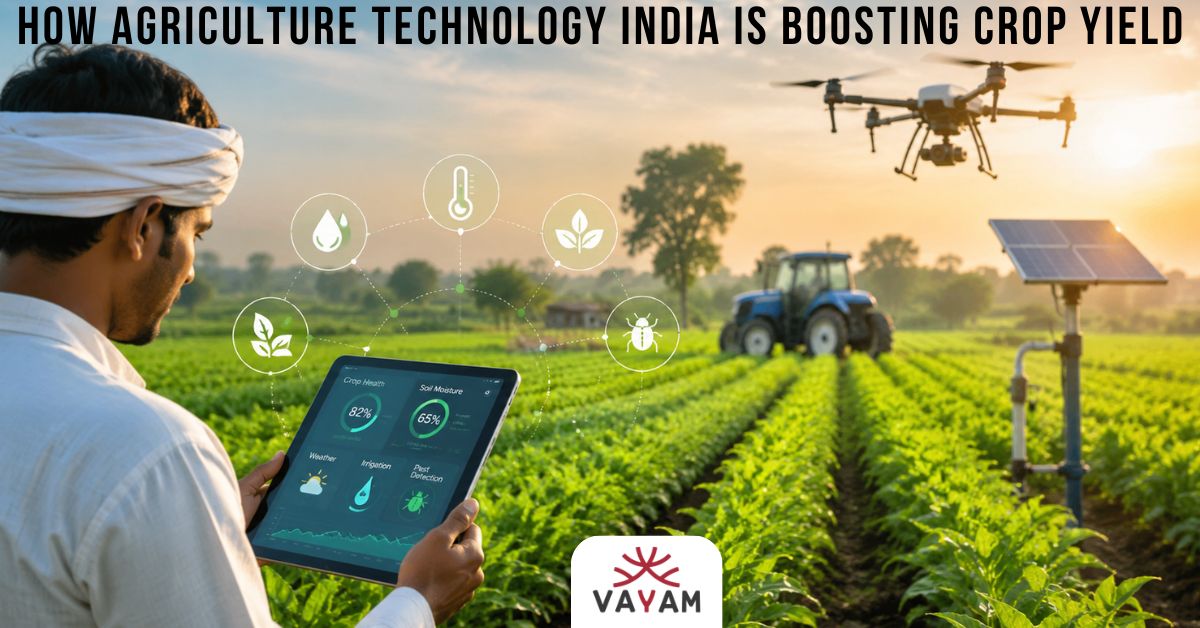
For India’s small farmers, one unpredictable monsoon can wipe out an entire season of work. Agriculture technology India is changing that, replacing guesswork with real data. Smart irrigation, soil health sensors, weather alerts and crop-monitoring apps now reach farmers through nothing more than a basic smartphone. In this guide, we will explain how these tools work, how much they can improve crop yield, and what still stops them from reaching every smallholder.
The Current State of Farming Challenges in India
Agriculture still makes up roughly 18-20% of India’s GDP and supports a massive share of the rural population. But the problems underneath that number haven’t really changed in decades: shrinking farms, fragmented land, unpredictable climate, and almost no access to real-time information when it matters most. These aren’t abstract policy issues either. They show up directly in what a farmer harvests at the end of the season.
Unpredictable Weather and Crop Loss
Monsoons have gotten harder to predict, heatwaves arrive with less warning, and for a farmer with no early alert system, even a two- or three-day gap in information can cost an entire crop. A frost warning that lands too late, or a heatwave that hits right at the wrong growth stage either one can flatten months of effort almost overnight.
Limited Access to Real-Time Market Data
Even a good harvest can turn into a loss if a farmer doesn’t know where the best price actually is that day. Without that information, middlemen usually end up capturing the value that should’ve gone straight to the farmer.
Traditional Guesswork in Sowing and Irrigation
When to sow, how much water to use, how much fertiliser to apply these decisions have traditionally come down to instinct and whatever the previous generation did. That worked fine when weather patterns were more stable. But as those patterns shift faster than old habits can keep up with, guesswork starts costing real money: wasted water, wasted fertiliser, and lower yields at the end of it.
How Technology in Agriculture India Is Changing the Game
This is roughly where things stood before Agriculture Technology India started moving from an expensive, research-lab concept into something an ordinary smallholder could actually use. Data got cheaper, phones got more affordable, and government subsidy programmes under initiatives like the Digital Agriculture Mission brought the cost of trying new tools down considerably.
Smart Irrigation and Water Management Systems
Smart irrigation runs on soil moisture sensors that tell the system exactly when a crop actually needs water, instead of watering on a fixed schedule regardless of need. It sounds small, but it meaningfully cuts water waste and makes yields more consistent, especially useful in areas already under groundwater stress.
Soil Health Sensors and Data-Driven Decisions
IoT sensors now let farmers check soil moisture, nutrient levels, and general soil health as it changes, in real time. Rather than spreading fertiliser evenly across a field out of habit, a farmer can target just the patches that actually need it, lower input costs, and improving overall crop health.
Weather Forecasting Tools for Farmers
AI-driven forecasting can flag frost, unseasonal rain, or an incoming heatwave several days out, enough of a head start to actually do something about it before the damage is done. What used to require real meteorological expertise now sits inside a free app.
Key Agritech Tools Helping Small Farmers Increase Yield
Beyond irrigation and weather forecasting, a whole ecosystem of agritech India tools has sprung up, each one chipping away at a different inefficiency baked into traditional farming.
- Mobile Apps for Crop Monitoring
Apps like Plantix and Kisan e-Mitra let a farmer snap a photo of a diseased leaf and get back an instant diagnosis plus a treatment suggestion early enough, ideally, to stop the disease before it spreads across the whole plot. It’s not replacing a farmer’s judgement. It’s more like a faster second opinion.
- Drone-Based Crop Assessment
Drones fitted with multispectral cameras can spot crop stress, disease, and pest infestations well before they would be visible during a manual walk-through. India’s agri-drone and IoT market is currently valued at around USD 2.5 billion, and precision spraying drones specifically are helping cut down chemical waste while improving how well it’s absorbed, which translates into healthier crops and lower costs. Some industry estimates put India’s overall drone market at roughly ₹3,900 crore and forecast it to grow to ₹11,500 crore over the next several years, with agriculture as one of the biggest drivers of that growth.
- AI-Powered Pest and Disease Detection
Machine learning tools now sift through large amounts of field data to flag pest outbreaks or disease risk before they’ve visibly spread, a real head start compared to the old wait-and-see approach.
Real Impact — Case Studies and Data
The numbers here are getting hard to argue with. Some industry analyses suggest that adding IoT devices into farming operations can lift crop yields by as much as 15%, mostly by cutting resource waste and improving the timing of decisions like irrigation and fertiliser use.
Yield Improvement Statistics from NGO-Led Programs
At scale, this looks even more significant. One large digital agriculture platform launched in 2024 brought together IoT sensors, drones, and AI analytics to support over 30 million farmers across the country, a good indicator of how far this kind of infrastructure can stretch once it’s actually built out. NGOs and government digital-literacy efforts matter just as much here, often acting as the bridge that helps a farmer genuinely understand and use a new tool, rather than just technically having access to it.
Farmer Testimonials and Field Results
Across smallholder farms, the pattern in reported results tends to repeat itself: farmers using soil sensors and scheduled irrigation report more predictable water use, and those using drone-based pest detection report catching problems early enough to avoid serious crop loss outcomes that are genuinely hard to match with manual observation alone, especially across large or scattered plots.
Challenges in Adopting Digital Agriculture in India
None of this progress has been effortless, though, and it would be misleading to suggest digital agriculture India has scaled smoothly.
Cost and Accessibility Barriers
Costs have dropped a lot, but certain tools- drones, especially- and more advanced sensor networks are still out of reach for the smallest farmers unless there’s subsidy support or some kind of shared-access model through cooperatives or NGOs.
Digital Literacy Gaps Among Farmers
Owning a smartphone and actually knowing how to use a crop-monitoring app well are two different things. Digital literacy gaps remain one of the biggest barriers here, particularly among older farmers and in regions where general education access is already limited.
Infrastructure Limitations
A lot of these tools still need steady electricity and internet and both remain patchy across large parts of rural India. A soil sensor is only as useful as the network and power supply keeping it running.
The Road Ahead — Scaling Smart Farming in India
The government’s own target is to lift agricultural productivity by roughly 30% through precision farming, pushing the sector’s overall output toward an estimated $450 billion. Getting anywhere close to that depends heavily on whether smart farming India tools actually reach the smallholders who make up most of the country’s farming population, not just the bigger, better-funded farms that usually adopt new tech first.
Role of Government Schemes and NGOs
Government subsidies for agri-drones and IoT devices, combined with NGO-led digital literacy programmes, are probably the two biggest levers for closing this gap. Subsidies bring down the upfront cost; NGOs and community programmes provide the hands-on training that actually turns access into use.
What Needs to Change for Wider Adoption
For technology in agriculture in India to really take hold, three things need to keep moving together: affordability, digital literacy, and reliable electricity/connectivity. Fix just one of these on its own and progress tends to stall. It’s the combination that actually decides whether a smallholder farmer benefits.
Conclusion — Why Technology for Farmers in India Matters
This is in no way about replacing judgement on the part of farmers and their work, simply providing them with better data to make judgements with. Weather forecasts that used to require real expertise, soil data that used to require the lab, and pest identification that required the expert eye is now all contained within tools that can be accessed directly by smallholders. The continuing adoption of these technologies with the support of government initiatives, private companies and NGO efforts, will only continue to narrow the gap between farming based on guesswork and farming based on data, with each field at a time.
What is agriculture technology in India?
It means using tools like sensors, drones, mobile apps and data analytics to help farmers make better decisions about irrigation, fertiliser, pests and selling.
How does technology increase crop yield?
By reducing waste and improves timing. Sensors show when to water, forecasts warn of bad weather, and apps catch diseases early.
Can small farmers afford agritech?
Many tools are now low cost or subsidised, and NGOs and cooperatives often provide shared access and training.